
FNIRSI DSO152
4.4Editor score
200kHz bandwidth
2.5MS/s sampling
Portable handheld design
Finding an affordable oscilloscope can be challenging for hobbyists and professionals alike. You need reliable performance without breaking the bank. This guide highlights ten budget-friendly models that deliver excellent value for money.
We evaluated each device based on bandwidth, sampling rate, display quality, and additional features like multimeters or signal generators. Our goal is to help you identify the best tools for diagnostics and testing.
Each pick showcases key specifications and real-world applications. Prices and availability change frequently, so verify details before purchasing. We aim to provide a comprehensive overview to streamline your decision-making process.
4.4Editor score

4.3Editor score
4.3Editor score
As an Amazon Associate we earn from qualifying purchases.
This table provides a side-by-side comparison of all ten models. Review the key specifications to find the perfect match for your testing requirements and budget constraints.


The FNIRSI DSO152 stands out as an accessible entry point for anyone needing basic waveform visualization. With a 4.4 rating, users appreciate its simplicity and portability. It is ideal for quick checks in automotive or educational settings.
We may earn a commission when you buy through this link, at no additional cost to you.
Its 2.5MS/s sampling rate and 200kHz bandwidth allow for viewing standard analog and digital signals. The one-key AUTO feature simplifies setup significantly. You can measure voltages up to 400V safely with the included probe.
While not suitable for high-frequency analysis, the trade-off is a very low cost and small form factor. The battery life is decent for fieldwork. It lacks advanced math functions but covers the basics well.
Hobbyists and students should consider this for routine diagnostics. It eliminates the need for complex assembly. For basic voltage checks and waveform viewing, this device offers unmatched value in the budget category.
The device weighs little and fits easily in a tool bag, making it perfect for on-site automotive repairs where space is limited.
One-button AUTO setup reduces the learning curve for beginners, allowing immediate waveform display without complex manual adjustments.
We may earn a commission when you buy through this link, at no additional cost to you.
The FNIRSI 2C53T earns our Editor's Choice for its versatility. Combining an oscilloscope, multimeter, and signal generator, it covers diverse diagnostic needs. Users rate it highly for its comprehensive feature set.
We may earn a commission when you buy through this link, at no additional cost to you.
With 50MHz bandwidth and 250MSa/s sampling, it handles a wider range of signals than the entry-level models. The multimeter supports AC/DC voltage and current. The signal generator outputs 13 waveforms up to 50kHz.
Advanced features like cursor measurement and waveform export via Type-C enhance usability. The FPGA architecture ensures stable capture. While not the smallest, it offers significant value for the price.
This model suits electronics technicians and serious hobbyists who need more than basic voltage checks. It consolidates three tools into one device. For versatile field testing, this is a top recommendation.
By integrating a multimeter and signal generator, this unit reduces the gear you need to carry, streamlining complex testing sessions.
Features like persistence mode and XY mode help analyze signal stability and relationships between channels effectively.
We may earn a commission when you buy through this link, at no additional cost to you.
The FNIRSI DSO-510 is designed for simple tasks. Its infinite afterglow feature helps capture intermittent signals that might otherwise be missed. It pairs well with the built-in signal generator.
We may earn a commission when you buy through this link, at no additional cost to you.
With 10MHz bandwidth and 48MS/s sampling, it is suitable for lower frequency signals. The device can output 13 waveform types. It includes standard features like waveform scaling and saving.
It is an affordable alternative for basic waveform observation. The battery life is decent. It is not ideal for complex digital debugging but works well for power supply checks.
Students and beginners will find this model user-friendly. It introduces oscilloscope functionality without overwhelming controls. For basic educational needs, it is a solid choice.
Infinite afterglow allows users to see signal traces over time, making it easier to spot noise or glitches in simple circuits.
The built-in generator allows immediate testing of circuits by applying known signals directly from the unit.
We may earn a commission when you buy through this link, at no additional cost to you.
The FNIRSI DPOS350P pushes boundaries with 350MHz bandwidth. This is rare in the budget category. It features a 7-inch touchscreen and supports 1GSa/s sampling for detailed signal inspection.
We may earn a commission when you buy through this link, at no additional cost to you.
Its 4-in-1 design includes a spectrum analyzer and frequency response analyzer. This allows for EMI checks and loop stability tests. The device is powerful for advanced debugging tasks.
While more expensive, it competes with mid-range instruments. The high refresh rate helps catch glitches. Battery life is substantial with 8000mAh capacity.
Engineers needing higher frequency analysis will appreciate this. It bridges the gap between basic and professional gear. For high-bandwidth needs on a budget, this is unique.
Built-in spectrum and frequency response analyzers enable professional-grade testing without external equipment.
The 7-inch touch screen offers intuitive control and better visibility for complex waveforms compared to smaller displays.
We may earn a commission when you buy through this link, at no additional cost to you.
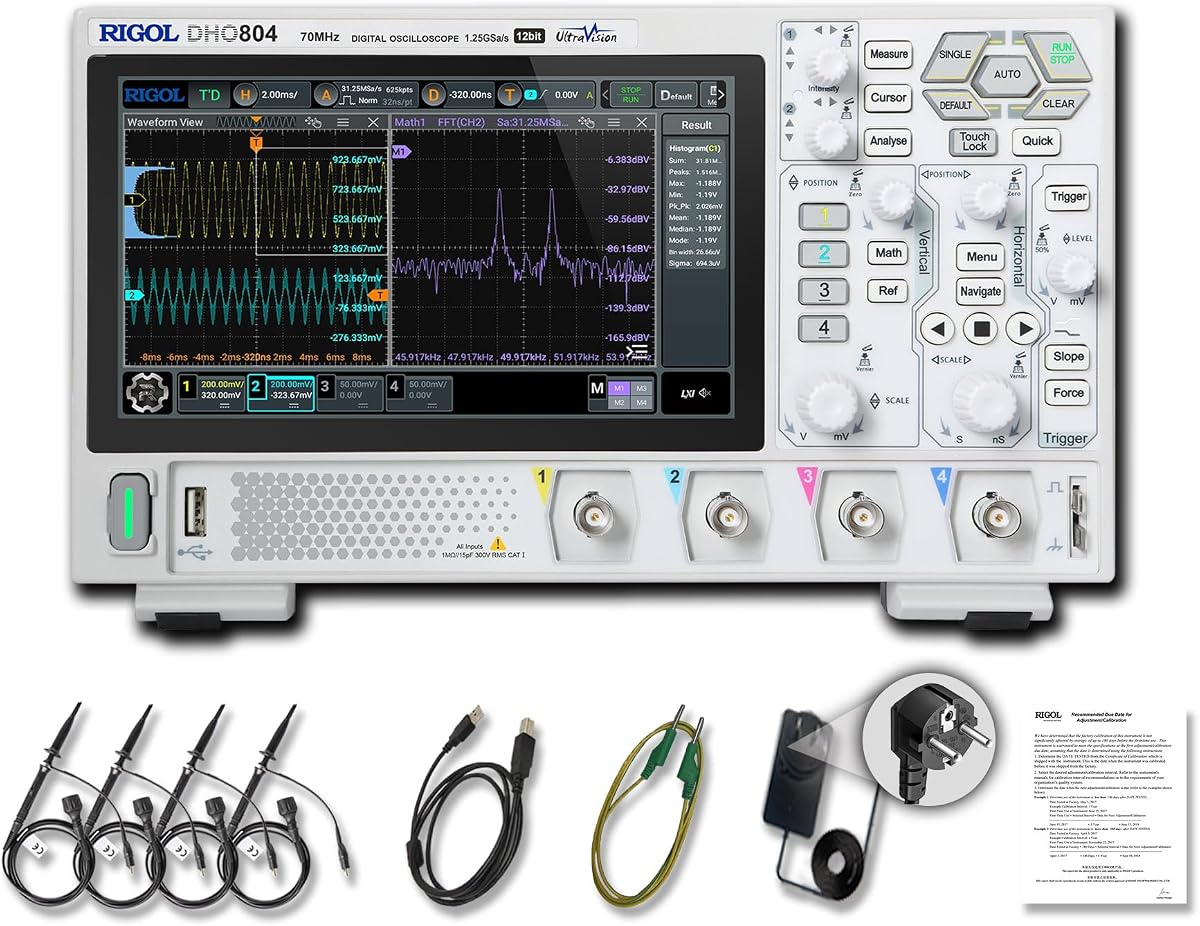
The RIGOL DHO804 is a professional portable oscilloscope. With 12-bit resolution and 4 channels, it delivers high fidelity. It is rated well for its precision and robust features.
We may earn a commission when you buy through this link, at no additional cost to you.
UltraAcquire technology captures millions of waveforms per second. This helps in finding intermittent glitches. Protocol decoding for CAN and RS232 supports embedded system debugging.
Memory depth of 25Mpts allows long capture times. Connectivity options include LAN and HDMI. It is heavier than handhelds but offers lab-quality performance.
Teams in R&D or automotive sectors should consider this. It handles complex multi-channel tasks efficiently. For precision work, this model is a top-tier choice.
12-bit vertical resolution provides fine detail in signal amplitude, essential for noise analysis and power ripple testing.
Built-in decoding for common serial protocols streamlines embedded system troubleshooting without external logic analyzers.
We may earn a commission when you buy through this link, at no additional cost to you.
The FNIRSI 2C53P offers a 4.3-inch IPS touch screen. This makes navigation intuitive. It features 50MHz bandwidth and 250MS/s sampling. It is part of the 3-in-1 family.
We may earn a commission when you buy through this link, at no additional cost to you.
The touchscreen allows direct interaction with waveforms. It includes FFT spectrum analysis and X-Y mode. The multimeter provides 19999 counts of precision.
While some users report a learning curve, the interface is modern. It supports automatic trigger modes. It is a capable device for mixed signal testing.
Users preferring touch interfaces will like this. It balances functionality and usability. For general electronic diagnostics, it provides good value.
The capacitive touchscreen simplifies zooming and cursor adjustments compared to traditional button-only controls.
Integrated FFT allows quick analysis of harmonic content without needing PC software or external tools.
We may earn a commission when you buy through this link, at no additional cost to you.
The FNIRSI 1013D Plus features 100MHz bandwidth and a 7-inch touchscreen. This combination offers a strong balance for professional use. Users appreciate the large screen for clarity.
We may earn a commission when you buy through this link, at no additional cost to you.
It supports 1GSa/s sampling and stores thousands of waveforms. Gesture controls make operation smooth. The device can handle up to 400V continuous voltage safely.
It is heavier due to the battery and screen size. However, the viewing area is excellent for detailed analysis. It includes Lissajous and FFT functions.
Technicians needing a balance of portability and screen real estate should choose this. It reduces eye strain during long sessions. For field service, it is a practical choice.
The 7-inch display ensures waveforms are easily readable even in bright environments, improving diagnostic speed.
Dedicated storage management allows organizing and reviewing captured waveforms efficiently on the device itself.
We may earn a commission when you buy through this link, at no additional cost to you.
The FNIRSI 2C23T is rated highly for simplicity. It includes a multimeter and signal generator for comprehensive testing. It is ideal for entry-level users.
We may earn a commission when you buy through this link, at no additional cost to you.
With 10MHz bandwidth, it handles most hobbyist tasks. The multimeter measures voltage and current accurately. Signal generation covers basic waveforms.
It is cost-effective and durable. The built-in protection adds safety. It is not for high-speed digital signals but great for analog learning.
Students and DIYers will find this easy to use. It reduces the learning curve. For basic home electronics repair, it is a strong candidate.
Simple controls help learners understand waveforms without getting bogged down by complex menus.
Having multimeter and generator capabilities in one unit saves space and cost for small workshops.
We may earn a commission when you buy through this link, at no additional cost to you.
The FNIRSI 2D15P offers 100MHz bandwidth and 500MS/s sampling. This makes it suitable for more complex signals. It features a TRMS multimeter for accurate readings.
We may earn a commission when you buy through this link, at no additional cost to you.
Memory depths vary to suit different needs. The device supports 13 parameters and math functions. It includes a signal generator for testing purposes.
It has a cooling fan to maintain stability. While this adds noise, it ensures performance. The battery supports extended field use.
For those needing more power than entry-level devices, this is a good middle ground. It balances specs and cost well. It serves automotive repair needs effectively.
True RMS multimeter capabilities provide reliable readings even for complex AC waveforms found in power systems.
Deep memory options capture long sequences, ensuring you do not miss intermittent events during analysis.
We may earn a commission when you buy through this link, at no additional cost to you.
This generic labeled device offers strong performance. Users rate it highly for its ease of use. It functions as a 3-in-1 unit. It is designed for automotive diagnostics.
We may earn a commission when you buy through this link, at no additional cost to you.
It offers 50MHz bandwidth and two modes for power and speed. The multimeter supports high counts. It can generate signals for testing circuitry.
Data transfer is efficient via Type-C. The device is built to withstand field conditions. It simplifies complex measurements with auto features.
Automotive techs should consider this. It reduces diagnostic time. For mobile repair work, it provides the necessary tools in a compact unit.
Automatic waveform recognition helps identify unknown signals quickly, speeding up the diagnostic workflow.
Built for automotive environments, it withstands vibrations and dust better than standard benchtop units.
We may earn a commission when you buy through this link, at no additional cost to you.
Selecting the right oscilloscope involves understanding your testing needs. Key factors determine performance and value. This section outlines the critical aspects to consider.
Bandwidth defines the maximum frequency the device can measure accurately. For general electronics, 10MHz to 50MHz is sufficient. Higher bandwidths like 100MHz or more are needed for digital signals or RF analysis.
Choose a bandwidth at least five times your signal frequency for accurate reproduction.
Sampling rate determines how many data points are captured per second. A rate of 50MS/s is basic, while 250MS/s or higher offers better detail. Higher rates prevent aliasing.
Look for a sample rate at least four times the bandwidth for faithful signal representation.
Most budget models offer two channels, which is standard for comparing signals. Four channels allow simultaneous monitoring of more data paths. Consider future needs when choosing channel count.
Two channels are usually enough for basic voltage and timing checks.
LCD screens vary in resolution and size. Touchscreens offer easier navigation. Brightness matters for fieldwork. A 7-inch screen improves readability but adds weight.
Prioritize resolution over size if space is a constraint.
Memory depth affects how long you can capture data. High depth helps analyze bursts. Standard models may have limited depth. Expandable memory is beneficial for complex signals.
Ensure enough memory to capture the longest transient you expect.
Many devices include multimeters or generators. These consolidate tools. FFT analysis and protocol decoding add value. Check if these features suit your workflow.
Integrated tools save space but may compromise on primary function quality.
USB-C and PC interfaces are essential for saving data. LAN and HDMI options exist on premium models. Ensure the device connects to your computer easily.
Standard USB-C is the minimum for modern data transfer.
Battery life varies by model. Built-in batteries are convenient for field use. Charging via Type-C is standard. Check capacity for your typical session length.
At least 4 hours of battery life is recommended for field work.
Always start by calibrating the probe and device before use. This ensures accurate readings and prevents damage to circuits. Connect the ground clip first to avoid shorts.
Use the AUTO function for quick setup. Adjust vertical and horizontal scales manually for detail. Enable triggering to stabilize waveforms. Avoid touching live circuits without proper protection.
Store the device in a dry place. Clean the screen with a soft cloth. Update firmware if available. Regular calibration maintains performance over time.
For most hobbyist projects, 10MHz to 20MHz is sufficient to view audio and low-speed digital signals. If you work with microcontrollers, 50MHz provides better clarity for clock lines.
Yes, many models support up to 400V and have automotive probes. However, ensure the ground clamp can handle engine heat and vibration before testing.
Most modern units have USB-C for data export, but many operate independently. PC software enhances analysis but is not strictly required for viewing waveforms.
Always check the probe rating. Some models claim high voltage but the probe is the limit. Never connect the ground clip to high voltage lines directly without isolation.
Use the built-in storage or export via USB. Some models support saving screenshots to a flash drive. Check the menu for file formats like PNG or CSV.
MS/s means megasamples per second, while GS/s means gigasamples. Higher rates capture faster signals better. Most budget scopes stick to MS/s to keep costs down.
We reviewed ten models ranging from basic to advanced. The FNIRSI DSO152 offers great value, while the RIGOL DHO804 delivers premium performance. Each option caters to specific needs.
Prioritize bandwidth and sampling rate based on your signals. If you need a multimeter or generator, look for 3-in-1 units. Portability matters for field work.
Prices and features change. Verify specs and user feedback before purchasing. With the right tool, you can diagnose issues efficiently and safely.