
Calibrite Display 123
4.0Editor score
USB C connection for fast setup
Supports up to two displays
Simple one two three workflow
This guide compares the best colorimeter for monitor calibration to help professionals and hobbyists choose the right tool for accurate color workflows.
Finding the right colorimeter for monitor calibration is essential for anyone who relies on accurate screen colors. Whether you edit photos, grade video, or design graphics, a calibrated display ensures what you see matches the final output. This guide helps you select the best tool for your needs.
We evaluated ten top-rated colorimeters based on sensor accuracy, software features, and compatibility with modern displays like OLED and Mini LED. Our comparison includes options for budget users and professionals who need advanced validation tools. Each product was reviewed for ease of use and long-term reliability.
Each pick highlights unique strengths such as dual display support, high luminance measurement, or integrated capture workflows. Prices and availability can change frequently so always check current listings before buying. We update this guide regularly to reflect the latest technology and user feedback.
4.0Editor score

4.2Editor score

4.0Editor score
This side-by-side comparison summarizes the key specifications and capabilities of each colorimeter to help you quickly identify the best fit for your workspace.


The Calibrite Display 123 is a straightforward colorimeter designed to simplify monitor calibration for beginners and budget conscious creators. With a rating of 4.0 stars it offers reliable performance for basic photo editing and color accurate viewing tasks.
We may earn a commission when you buy through this link, at no additional cost to you.
Its standout quality is the Easy 1 2 3 software workflow that guides users through calibration without complex settings. The USB C connection ensures fast data transfer while the built in before and after check lets you visually confirm accuracy improvements immediately.
While it lacks the advanced controls of higher end models the simple approach makes it ideal for those who need quick results. The dual display support is a generous feature at this price point allowing consistent color across multiple screens.
This device is best for hobbyists or entry level professionals who want to stop guessing about screen colors. If you need basic calibration without a steep learning curve this colorimeter delivers solid value and consistent results.
The guided workflow reduces setup time significantly making calibration accessible even for those new to color management tools.
Supporting up to two displays ensures that secondary screens match your primary monitor for a unified workspace experience.
We may earn a commission when you buy through this link, at no additional cost to you.
The Calibrite Display Plus HL stands out as a premium colorimeter built for high brightness and HDR capable displays. With a rating of 4.0 stars it handles Mini LED OLED and Super Bright panels with precision that standard tools cannot match.
We may earn a commission when you buy through this link, at no additional cost to you.
Its Advanced HL Sensor measures up to 10000 nits ensuring accurate calibration for video editors and colorists working with HDR content. The included PROFILER Software offers full adjustment control including custom patch sets and shared presets for team workflows.
While the price is higher than entry level options the validation tools like Uniformity Check and Profile Validation provide professional grade trust. Supporting broadcast standards like Rec.709 and BT.1886 makes it suitable for serious post-production environments.
Professional video editors and those with high end displays should consider this tool for reliable monitoring. It bridges the gap between consumer calibrators and studio grade equipment offering flexibility and accuracy for demanding visual tasks.
Measuring up to 10000 nits allows accurate profiling of the brightest modern monitors used in HDR content creation.
Features like Quick Check and Uniformity Check help you trust the calibration result before finalizing your workflow.
We may earn a commission when you buy through this link, at no additional cost to you.
The datacolor Spyder Calibrator is a versatile tool that balances speed with modern display compatibility. Rated 4.2 stars it is designed for today's digital workflows including OLED mini-LED and Apple Liquid Retina XDR screens.
We may earn a commission when you buy through this link, at no additional cost to you.
Its ambient light sensor tracks room light to help you adjust display brightness to ideal levels automatically. This feature prevents eye strain and ensures consistent results even when your workspace lighting changes throughout the day.
Calibration takes about 90 seconds making it one of the fastest options available for quick color confidence. The DevicePreview feature simulates how your photos will look on other devices adding an extra layer of accuracy to your editing.
This colorimeter is ideal for photographers who need reliable results without spending hours on setup. Its adaptability to light shifts and fast workflow makes it a top choice for dynamic creative environments.
The ambient light sensor ensures your display settings remain optimal even as natural or artificial light changes in your room.
With a 90 second calibration time you can recalibrate frequently without disrupting your creative momentum.
We may earn a commission when you buy through this link, at no additional cost to you.
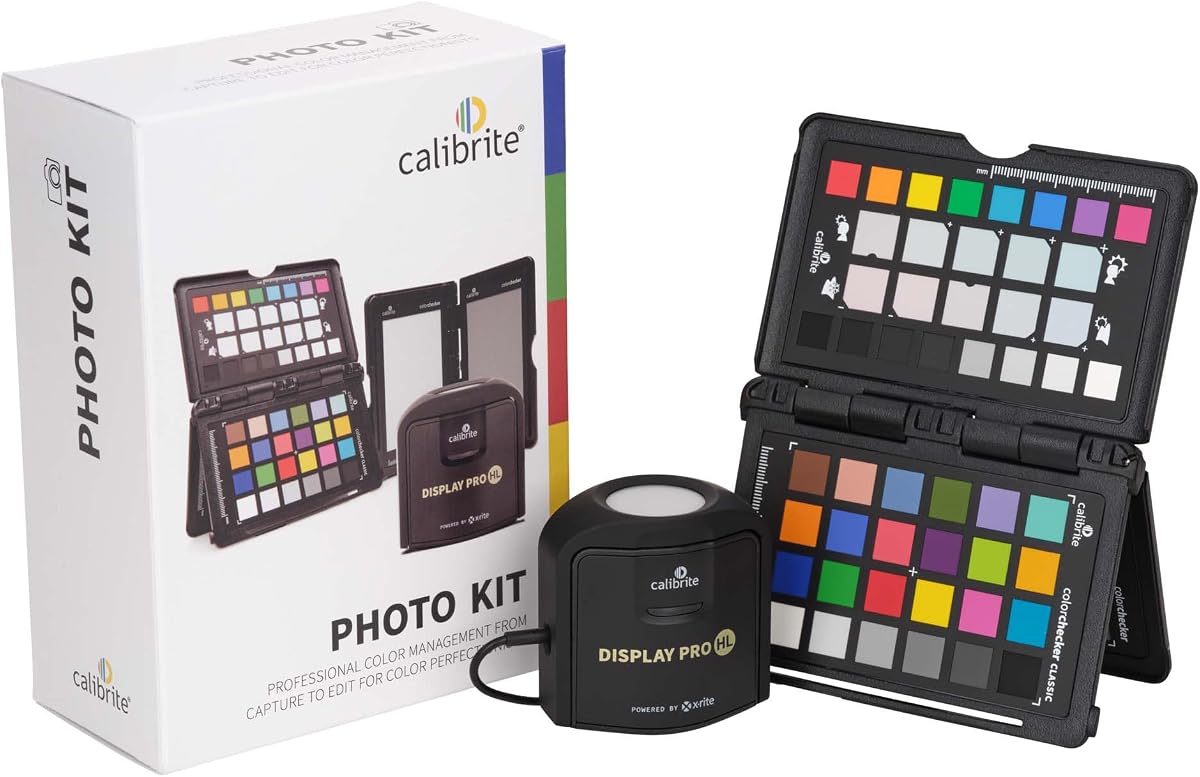
The Calibrite Photo Kit combines a Display Pro HL colorimeter with a ColorChecker Passport Photo 2 for a complete capture to edit workflow. Rated 4.5 stars it supports custom camera profiles and accurate monitor calibration for modern display technologies.
We may earn a commission when you buy through this link, at no additional cost to you.
This kit helps photographers reduce color guesswork by ensuring consistent results from camera capture through final editing. The Display Pro HL calibrates modern laptop and desktop displays so what you see matches your final output on other devices.
Passport Photo 2 enables custom camera profiles for RAW workflows improving repeatability and reducing unwanted shifts before retouching. The included PROFILER software provides presets and customizable targets for refined creative color management.
Photographers who want a unified system for both their camera and screen should consider this comprehensive kit. It bridges the gap between capture and post production ensuring your vision is preserved throughout the process.
Combining camera profiling and monitor calibration creates a seamless process from shooting to editing.
The Display Pro HL handles Mini LED OLED and Apple XDR panels for accurate preview of high dynamic range content.
We may earn a commission when you buy through this link, at no additional cost to you.
The Calibrite Creator Kit includes a Display 123 colorimeter and ColorChecker Passport Video 2 for photographers and filmmakers. Rated 5.0 stars it is designed for exposure reference white balance setup and consistent color workflow from capture through edit.
We may earn a commission when you buy through this link, at no additional cost to you.
Passport Video 2 helps set accurate white points and verify exposure making it reliable for matching multiple cameras on set. The Display 123 provides an easy monitoring workflow so creators can trust on-screen color when editing and grading.
This kit reduces trial-and-error corrections improving workflow efficiency for hybrid shooters who handle both stills and video. It supports accurate results for professional video production by maintaining consistent standards across cameras and monitors.
Hybrid creators who need reliable color standards across multiple cameras and displays will find this kit invaluable. It simplifies color management so you can focus on creativity rather than technical corrections during post-production.
The Video 2 allows you to match multiple cameras quickly ensuring uniformity across different shoots and lighting conditions.
By starting with accurate color the editing process becomes faster and more reliable for final delivery.
We may earn a commission when you buy through this link, at no additional cost to you.
The Calibrite ColorChecker Display Pro offers powerful profiling with high repeatability across different display types. Rated 4.2 stars it features an optical design that supports table top projector profiling and ambient light measurement.
We may earn a commission when you buy through this link, at no additional cost to you.
Its rotatable diffuser arm serves as a stand for projector profiling or as a cover for instrument optics. The integrated tripod mount allows for stability during larger venue profiling making it adaptable for diverse environments.
While it relies on ccProfiler or i1Profiler software its ease of use makes it a strong option for consistent color profiles. The design ensures that repeated measurements on the same display remain stable over time.
This device is suitable for professionals who need reliable data across various display setups including projectors. Its mechanical features add flexibility for specialized calibration tasks beyond standard desktop monitors.
The rotatable diffuser and tripod mount provide physical flexibility for unique profiling scenarios like projectors.
The optical design ensures consistent results even when measuring different display technologies over time.
We may earn a commission when you buy through this link, at no additional cost to you.
The Datacolor Spyder5PRO is designed for serious photographers and designers who need fast accurate color calibration. Rated 4.3 stars it offers room light monitoring to determine optimal monitor brightness for shadow detail and highlights.
We may earn a commission when you buy through this link, at no additional cost to you.
Its before and after evaluation feature lets you view results using your own photographs to focus on important details. The Display Analysis feature evaluates and compares the performance of all laptop and desktop monitors in your workspace.
Full calibration takes about five minutes ensuring color accuracy that reduces wasted ink and paper in printing cycles. This model balances simplicity with professional results making it a reliable choice for traditional photography workflows.
Photographers who prefer established tools with proven stability will appreciate this device. It remains a solid option for ensuring your prints match your screen even in a digital dominated world.
Room light monitoring helps you adjust brightness so your screen shadows and highlights match printed outputs accurately.
Using your own photos for before and after checks ensures the calibration benefits your specific workflow.
We may earn a commission when you buy through this link, at no additional cost to you.
The ASUS ProArt CaliContrO MCA02 is a 3-in-1 colorimeter with Display OSD control and ASUS Dial features. With a rating of 1.5 stars it is designed for long-term color accuracy and consistency with hardware software calibration.
We may earn a commission when you buy through this link, at no additional cost to you.
It measures up to 10000 nits for precise HDR calibration and is compatible with LED OLED and Mini-LED panels. The reversible USB-C connection ensures quick connectivity while the 5-way navigator provides intuitive display control.
The integrated ASUS Dial provides customized shortcuts for easy precise control of creator software. However user feedback suggests integration may vary so testing compatibility with your setup is recommended before purchase.
Users seeking hardware calibration on ASUS displays may find the additional features useful. It aims to unify color management and display control in one device for streamlined creative workflows.
The hardware calibration capability helps maintain long-term accuracy better than software-only solutions on compatible displays.
The ASUS Dial offers quick shortcuts for creator apps but works best within the ProArt ecosystem.
We may earn a commission when you buy through this link, at no additional cost to you.
The Datacolor Spyder4Pro features improved accuracy and stability with double-shielded color filters. Rated 4.2 stars it supports multiple displays with a single sensor and offers an automated calibration and brightness adjustment process.
We may earn a commission when you buy through this link, at no additional cost to you.
Its average accuracy is up 26% compared to previous generations with better consistency between units. The ReCAL feature makes it quick and easy to recalibrate your display to compensate for changes over time.
The full-spectrum color sensor ensures a closer match to CIE color standards for reliable long-term use. This model is a budget-friendly option for those who value stability over cutting-edge features.
Users needing consistent results without complex workflows will appreciate this tool. It provides a solid foundation for color accuracy in home offices and small studios.
The ReCAL feature allows you to quickly update your display profile without running a full calibration every time.
These filters improve sensor stability and accuracy ensuring your color data remains reliable over time.
We may earn a commission when you buy through this link, at no additional cost to you.
The Datacolor Spyder X Pro offers a groundbreaking lens-based color engine for high accuracy. Rated 4.4 stars it is ideal for first-time users with features like one-click calibration and room-light monitoring.
We may earn a commission when you buy through this link, at no additional cost to you.
It ensures accurate color for photographic images with automatic profile changing and precise screen color detail. The SpyderProof functionality provides before-and-after evaluation so you can see the difference using your own images.
Calibration takes just a minute or two making it quick and easy for busy creatives. Supporting multiple laptops and desktop monitors allows for consistent color across a larger workspace.
New users who want a straightforward path to accurate color will find this tool excellent. It simplifies the process while delivering professional results that enhance your editing confidence.
The lens-based engine provides a higher level of precision compared to older sensor designs.
SpyderProof lets you visually confirm improvements using your own photos so you trust the results.
We may earn a commission when you buy through this link, at no additional cost to you.
Choosing the right colorimeter depends on your display type and workflow needs. This section covers key factors to help you make an informed decision.
Ensure the colorimeter supports your monitor type whether it is LCD OLED Mini LED or Super Bright panels. Advanced models measure high luminance up to 10000 nits which is critical for HDR content creation.
Check product specs for OLED and XDR compatibility to avoid calibration errors on modern screens.
Look for software that offers both basic and advanced modes. Features like custom patch sets shared presets and validation tools help professionals maintain consistency across teams.
Software with device simulation or ambient light tracking can further refine your workflow.
High-quality sensors with double-shielded filters or lens-based engines provide better accuracy over time. Stability ensures your calibration results remain reliable across multiple sessions.
Check for independent reviews on sensor stability to confirm long-term performance.
Guided workflows like one two three steps or wizards make calibration accessible for beginners. Fast calibration times allow you to recalibrate frequently without disrupting your work.
Consider models with before-and-after views to easily confirm visual improvements.
Mechanical design aspects like tripod mounts or rotatable diffusers add versatility for projector or ambient light measurement. USB-C connections ensure fast data transfer and modern connectivity.
Devices with counterweights or stands improve stability during the calibration process.
Budget models offer essential calibration while premium kits include camera profiling or advanced validation. Determine which features truly impact your workflow before investing in high-end tools.
A mid-range option often balances cost and features for most creative professionals.
If you use multiple screens ensure the colorimeter supports profiling several displays at once. Consistent color across primary and secondary monitors prevents eye strain and visual inconsistencies.
Software that manages multiple profiles simultaneously simplifies complex workspace setups.
Displays drift over time so frequent recalibration is necessary. Tools with quick recalibration features help you maintain accuracy without spending hours each month.
Auto-profile changing based on room light can automate adjustments when lighting changes.
Start by warming up your monitor for at least 30 minutes before calibration to ensure stable brightness and color output. This step prevents shifts during the profiling process.
Place the colorimeter directly on the display center avoiding reflections or direct light falling on the screen. Use counterweights or stands if provided to keep the device steady throughout the cycle.
Follow the software prompts to set your target white point and gamma. Repeat calibration every month or whenever your display behavior changes to maintain consistent color accuracy.
You should calibrate your monitor at least once a month to maintain accurate color. Professional workflows may benefit from weekly recalibration especially if your screen is used frequently or lighting changes often.
Yes many modern colorimeters support OLED displays. Check that the specific model lists OLED compatibility before buying to ensure accurate profiling for self-emissive panels.
For most users a colorimeter is sufficient for monitor calibration. Spectrophotometers are typically used for printer profiling or advanced color matching which may not be necessary for screen work.
HDR calibration ensures your monitor displays high dynamic range content correctly. You need a colorimeter that measures high brightness levels typically over 1000 nits to support this workflow accurately.
Monitors naturally shift in brightness and color as components age. Temperature and ambient light also affect perception. Regular calibration compensates for these physical changes and keeps color reliable.
Yes every colorimeter works with dedicated software to create profiles. Most manufacturers include their own tools so check software features and compatibility before purchasing the device.
Many colorimeters support multi-monitor profiling allowing you to match screens in a dual setup. Check the software capabilities to confirm it handles multiple display profiles efficiently.
Yes ambient light can alter how your screen colors appear. Look for colorimeters with built-in sensors that adjust brightness based on room conditions for consistent accuracy.
Choosing the right colorimeter depends on your specific workflow needs. For budget users the Calibrite Display 123 offers simple effective calibration. Professionals needing HDR support should consider the Calibrite Display Plus HL for its advanced luminance measurement.
Prioritize models that match your display technology such as OLED or Mini LED panels. Software features like ambient light tracking and multi-monitor support can significantly improve long-term consistency and workflow efficiency.
Prices and stock levels change frequently so always verify current listings before purchasing. This guide updates regularly to reflect the latest tools and user feedback to help you stay current.