
Creality Otter Lite Basic
5.0Editor score
0.05mm High Precision
Full Color Texture Mapping
Portable Plug and Play
This guide compares the top 3D scanners for reverse engineering, covering accuracy, speed, and software compatibility to help you choose the right tool.
Reverse engineering demands precise digital copies of physical objects. A good 3D scanner captures geometry quickly, handles difficult surfaces, and exports clean data for CAD work without excessive post-processing.
We evaluated ten professional handheld and structured light scanners against real engineering tasks. Criteria included point accuracy, mesh quality, outdoor performance, and software workflows for seamless CAD conversion.
Each pick highlights specific strengths like laser precision or wireless freedom. Note that pricing varies by retailer and configuration. Always verify current specs before purchasing for your specific project needs.
5.0Editor score

4.8Editor score

4.7Editor score
Below is a side-by-side comparison of all ten scanners reviewed in this guide. Use this table to quickly compare key specifications, scanning modes, and ideal use cases.



The Revopoint MetroX Pro stands out as our top pick for reverse engineering due to its industrial-grade precision. It delivers single-frame accuracy up to 0.02 mm and volumetric accuracy of 0.02 mm + 0.04 mm per meter.
We may earn a commission when you buy through this link, at no additional cost to you.
Its blue laser technology eliminates the need for spray on dark or shiny surfaces, ensuring a clean workflow. The four scanning modes, including cross-line and parallel lines, provide versatility for everything from flat parts to complex geometry.
While the hardware is exceptional, the workflow depends on Revo Design or Revo Measure, which are paid add-ons. This adds to the total cost but ensures professional-grade post-processing capabilities for tight tolerance requirements.
We recommend this scanner for engineers and designers who need high fidelity for industrial measurement. The ability to stream scans to a mobile device adds flexibility, making it ideal for complex assemblies where laptop access is limited.
The blue laser allows capturing reflective surfaces without markers or spray. This saves time and keeps parts clean during inspection workflows.
Revo Mirror enables you to view data on a tablet or phone instantly. This helps catch gaps early and reduces repeated scanning sessions.
We may earn a commission when you buy through this link, at no additional cost to you.
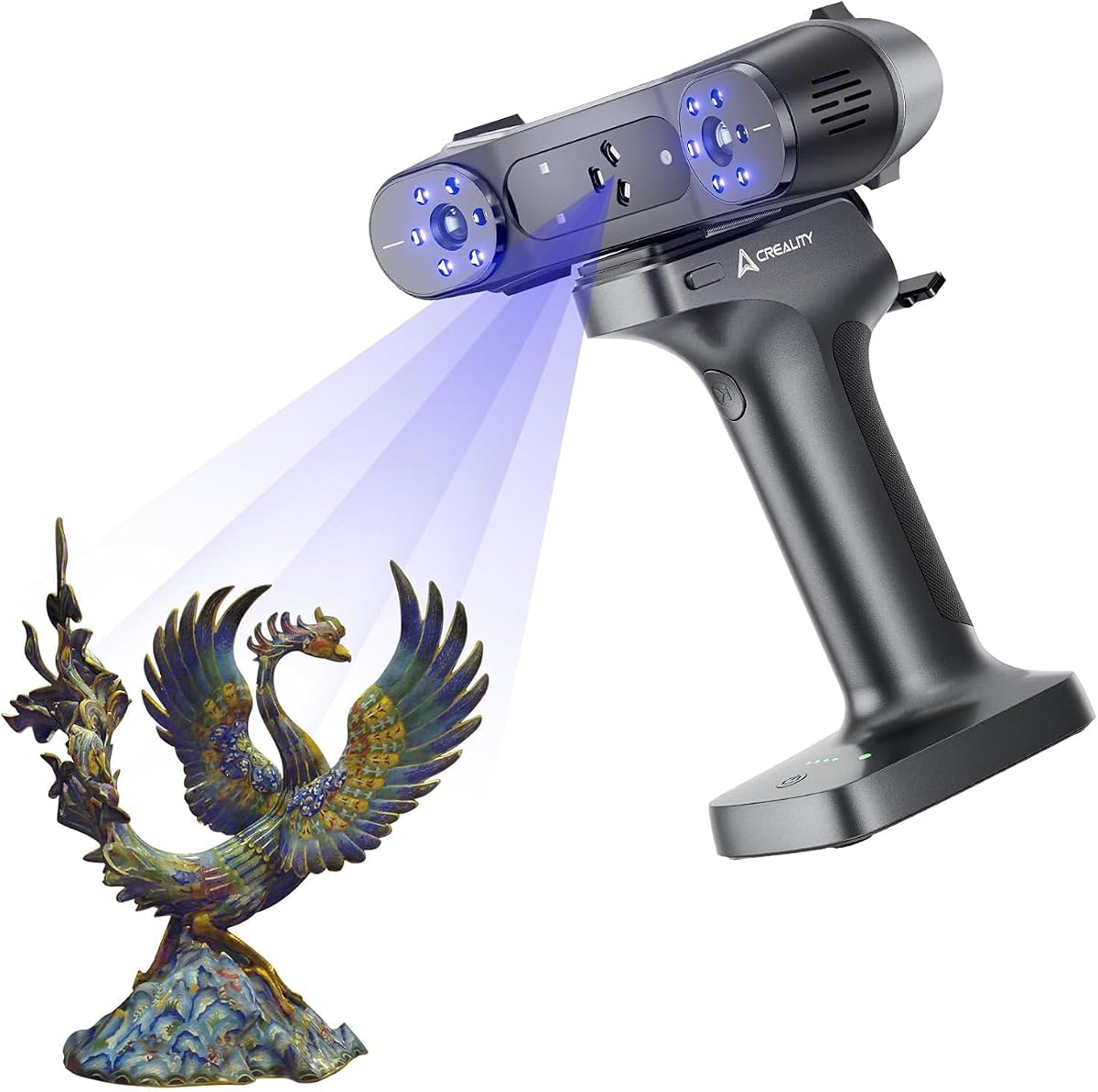
The Creality Otter Lite Basic offers a compelling entry point for hobbyists and small businesses needing reverse engineering capabilities. With 0.05 mm resolution, it handles small parts effectively and captures full-color textures at 30 fps.
We may earn a commission when you buy through this link, at no additional cost to you.
Its dual scanning modes allow you to switch between close range and long-range work. This flexibility helps capture details on small objects or larger assemblies without needing multiple devices.
While it lacks the extreme precision of metrology scanners, it is sufficient for many prototyping and 3D printing needs. The included kit ensures you have everything required to start immediately.
This is an excellent choice for those on a budget who need reliable data for general engineering tasks. Its portability and user-friendly interface make it a strong contender for educational and maker spaces.
At a lower price point, it offers solid performance for non-critical applications. It bridges the gap between toy scanners and professional equipment.
The package includes turntable, markers, and cleaning tools. This reduces hidden costs and helps you begin scanning right out of the box.
We may earn a commission when you buy through this link, at no additional cost to you.
The EinScan Rigil represents the pinnacle of wireless 3D scanning technology. With onboard computing and hybrid light source technology, it delivers 0.04 mm accuracy while freeing you from cables and PC tethering.
We may earn a commission when you buy through this link, at no additional cost to you.
Its ability to scan in bright sunlight makes it ideal for field work or large outdoor inspections. The 32 GB DDR5 RAM ensures smooth handling of massive point clouds without stuttering or latency.
While expensive, the rigidity and autonomy justify the cost for professional teams needing reliability on site. The inclusion of one-on-one training adds significant value for mastering advanced workflows.
We recommend this scanner for automotive or aerospace engineers working in diverse environments. The combination of speed, precision, and wireless convenience makes it a top-tier tool for reverse engineering.
Onboard computing allows the scanner to process data independently. This removes the bottleneck of transferring data to a PC during capture.
Many scanners fail in direct sun, but the Rigil handles up to 100,000 lux. This ensures accurate data even in uncontrolled lighting conditions.
We may earn a commission when you buy through this link, at no additional cost to you.
The Creality CR-Scan Raptor Pro brings a robust hybrid laser setup to the table. It features 22 crossed and 7 parallel blue lasers, delivering 0.02 mm accuracy and capturing 660,000 dots per second.
We may earn a commission when you buy through this link, at no additional cost to you.
Its temperature compensation algorithm ensures stable performance even in varying thermal conditions. This reliability is crucial for industrial environments where consistency is key for repeatable measurements.
The dual-mode scanning allows quick capture of large areas while retaining detail for intricate features. The infrared structured light component helps avoid sticking points on feature-rich objects.
This scanner is ideal for users needing a versatile tool for both small and large engineering parts. Its ability to scan black metal directly saves significant prep time in the lab.
The combination of high frame rates and multiple laser lines allows fast scanning without sacrificing accuracy. This is vital for production line checks.
Unlike many scanners limited to Windows, this model supports macOS. This flexibility makes it accessible for mixed OS teams.
We may earn a commission when you buy through this link, at no additional cost to you.
The Revopoint INSPIRE 2 is designed for portability and outdoor flexibility. Weighing just 190g, it allows for extended handheld scanning without fatigue, making it easy to carry on site.
We may earn a commission when you buy through this link, at no additional cost to you.
Its infrared laser lines handle dark and reflective surfaces without spray, and it operates reliably in outdoor lighting up to 20,000 lux. The built-in optical zoom helps focus on specific features.
While the 0.05 mm accuracy is not as tight as the Metro series, it is sufficient for general prototyping and reverse engineering of consumer goods. The calibration board boosts point cloud consistency significantly.
We recommend this for field engineers or designers needing a portable tool. The inclusion of outdoor filters and wireless streaming makes it a practical choice for dynamic work environments.
The lightweight aluminum alloy design makes this scanner easy to pack. It fits into standard backpacks without adding significant weight.
Adjustable optical zoom allows you to project light precisely on small features. This helps capture intricate details on mixed geometry surfaces.
We may earn a commission when you buy through this link, at no additional cost to you.
Revisiting the Otter Lite Basic highlights its consistency as a reliable entry-level tool. It captures true-to-life color textures and exports to STL or OBJ, making it ideal for immediate 3D printing or basic reverse engineering.
We may earn a commission when you buy through this link, at no additional cost to you.
The LED indicators guide scanning distance, reducing user error for beginners. With compatibility for Windows and macOS, it fits into various existing workflows without needing new hardware.
While it does not match the speed of laser scanners, its ease of use lowers the barrier to entry. It is perfect for educational institutions or DIY projects requiring decent accuracy.
We recommend this for students or hobbyists starting with reverse engineering. The comprehensive kit and smart feedback ensure a smooth learning curve for first-time users.
Multi-color LEDs provide instant visual feedback on distance and status. This helps maintain steady movement and better scan overlap.
Support for OBJ, STL, and PLY formats ensures you can export to most CAD tools. This broad compatibility prevents data bottlenecks.
We may earn a commission when you buy through this link, at no additional cost to you.
The standard version of the MetroX Pro offers similar high-precision capabilities to the advanced variant. It features 0.01 mm single-frame precision and volumetric accuracy suitable for industrial measurement and reverse engineering tasks.
We may earn a commission when you buy through this link, at no additional cost to you.
The auto turntable simplifies scanning small complex parts. The HD RGB camera captures vivid colors in turntable mode, adding realism to the digital twin. Streaming features allow free movement during the process.
As with other models, the paid software ecosystem is a consideration. However, the hardware performance ensures clean data ready for professional CAD integration. It is a robust tool for detailed part analysis.
We recommend this for designers who need precision without the highest price tag. It balances cost and performance well for mid-range industrial applications.
Automated scanning reduces user fatigue and ensures consistent rotation. This leads to better data alignment for complex shapes.
The RGB camera captures true colors for better visual representation. This helps in design review and client presentations.
We may earn a commission when you buy through this link, at no additional cost to you.
This iteration of the Raptor Pro emphasizes outdoor readiness and large object scanning. It maintains metrology-grade accuracy and can withstand up to 100,000 lux, making it suitable for field inspections in direct sun.
We may earn a commission when you buy through this link, at no additional cost to you.
The face and body mode is a standout feature, allowing full-body scans in just two minutes. This is ideal for ergonomic design and medical applications. The software includes tutorials for streamlined use.
System requirements are high, suggesting a need for dedicated hardware for best performance. However, the flexibility and range make it a top choice for automotive or large assembly reverse engineering.
We recommend this for professionals needing to scan vehicles or large machinery. The wireless capabilities and outdoor resilience ensure data capture in any environment.
The laser configuration resists sunlight interference effectively. This allows accurate scanning on the shop floor or outdoors without shade.
Rapid full-body capture helps design fitting apparel or ergonomic seats. It simplifies human-related reverse engineering tasks significantly.
We may earn a commission when you buy through this link, at no additional cost to you.
The Raptor X focuses on speed and wireless efficiency. With 34 cross laser lines, it scans medium to large objects quickly. WiFi 6 ensures data transfers at up to 4.7 Gbps with minimal latency.
We may earn a commission when you buy through this link, at no additional cost to you.
The battery charges to 80% in just 1.5 hours, supporting long sessions. Anti-shake technology and speckle matching help maintain tracking even with hand jitter. This ensures stable data capture for smooth workflows.
Its ability to scan without markers simplifies the process further. While the price is high, the performance and connectivity justify it for teams needing rapid turnaround times.
We recommend this for engineers requiring fast, high-fidelity scans. The combination of speed, battery life, and wireless power makes it a top-tier tool for dynamic projects.
WiFi 6 transfers scans faster than standard connections. This reduces the wait time between capture and processing.
Stabilization algorithms ensure smooth tracking during handheld operation. This reduces the risk of losing alignment mid-scan.
We may earn a commission when you buy through this link, at no additional cost to you.
This final entry reinforces the Raptor Pro's capabilities for diverse scanning needs. It maintains 0.02mm metrology grade accuracy and offers a unique face mapping algorithm for capturing fine human features.
We may earn a commission when you buy through this link, at no additional cost to you.
The dual blue laser mode ensures rapid coverage of large objects. The software supports adjustable resolution, allowing users to trade speed for detail as needed. This adaptability suits various reverse engineering applications.
While it shares specs with other Raptor models, its focus on body scanning adds value for design and medical use. The wireless support adds convenience for field work and flexible setups.
We recommend this for teams needing both industrial precision and human body scanning. It is a versatile option for mixed use cases in product development.
Specialized algorithms capture fine details like hair. This is rare in standard industrial scanners and adds value.
Adjustable resolution allows balancing file size and detail. This helps manage storage and processing times.
We may earn a commission when you buy through this link, at no additional cost to you.
Selecting the right scanner requires balancing precision, speed, and software compatibility. We break down the key factors to consider for your specific engineering workflow.
Accuracy determines how close the scan is to the actual object. For reverse engineering, look for sub-millimeter accuracy to ensure your CAD parts fit perfectly.
Precision relates to repeatability. High precision means consistent results across multiple scans.
High frame rates reduce capture time and prevent motion blur. This is vital for large assemblies or production lines.
Faster scans mean more data points collected per second, improving mesh quality.
Many industrial parts are shiny or black. Blue laser or infrared options allow scanning without spray.
Avoiding spray saves prep time and protects delicate components during the process.
Check if the scanner supports export to CAD formats like STEP or STL. Compatibility with tools like SolidWorks is key for reverse engineering.
Some brands require paid software licenses for full functionality. Ensure this fits your budget.
Wireless scanning provides freedom to move around the object. Look for Wi-Fi 6 for high-speed data transfer.
USB-C and stable drivers ensure reliable connection to your workstation during long sessions.
Lightweight scanners allow for field work and handheld operation. Consider weight and battery life for outdoor projects.
If you need to transport the device daily, a durable case and compact design are essential.
Ensure the scanner covers your typical part sizes. Some models work best for small parts while others handle large machinery.
Versatility allows you to scan both components and assemblies with one device.
Balance the initial cost with productivity gains. A faster scanner may pay for itself through time savings.
Consider long-term software costs and hardware durability when calculating total cost of ownership.
Start by calibrating your scanner on a flat surface to ensure accuracy. Clean the lens before every session to avoid dust affecting the data.
Scan in smooth, overlapping movements. Move the scanner in a circular motion to capture all sides of the object evenly.
Store the device in a cool, dry place. Charge the battery fully after each session and keep the carrying case organized for easy access.
Many modern scanners with blue laser technology do not require spray powder. They can scan shiny or dark metal surfaces directly. This saves time and keeps parts clean. Check your model specifications to confirm support.
STL and OBJ are standard for meshes, but STEP or IGES are preferred for CAD. Many scanners convert meshes to parametric models. Check software support for export formats like STL, OBJ, or PLY.
Some industrial scanners can operate in bright sunlight. Look for laser scanners rated for high lux levels. Avoid direct sun on the scanner lens. Shaded outdoor areas improve data quality.
Export your mesh as a STEP or OBJ file from your scanning software. Import it into SolidWorks and use scan-to-CAD tools to create parametric features. Ensure your license supports reverse engineering modules.
High-end scanners require a dedicated graphics card and at least 16GB of RAM. A multi-core processor helps with data processing. Check the vendor for minimum system requirements to avoid lag.
Calibrate before every major session. If the device is moved frequently or dropped, recalibrate immediately. This ensures consistent data accuracy and prevents alignment errors in your workflow.
Structured light projects a pattern and measures deformation. Laser measures distance directly. Laser is better for dark surfaces while structured light offers high detail for lighter materials.
Yes, most modern handheld scanners capture 24-bit color. This adds texture data to the geometry. It is useful for product design and visual inspection but optional for dimensional accuracy.
We have reviewed ten top scanners capable of precise reverse engineering. The Revopoint MetroX Pro leads in accuracy, while the Creality Otter Lite Basic offers the best entry-level value.
Prioritize the features that match your needs. If you work on metal surfaces, blue laser is essential. For portability, the INSPIRE 2 stands out as a lightweight option.
Prices change frequently across retailers. Always check current availability and warranty terms before purchasing to ensure you get the best value for your engineering work.