
Askar 71F Flat-Field Telescope 71mm Aperture
4.9Editor score
Quadruplet air-Spaced APO design
Lightweight 2.5kg OTA weight
360 degree field rotation
Discover the top apochromatic refractors for astronomy enthusiasts. This guide compares optical quality, portability, and astrophotography capabilities to help
Apochromatic refractors represent the pinnacle of optical design for serious amateur astronomers seeking crisp, color-free views. These telescopes use special glass elements to eliminate chromatic aberration, delivering sharp images of planets and deep sky objects alike.
We have evaluated ten leading models based on optical performance, build quality, and suitability for visual observation versus astrophotography. Our analysis considers aperture, focal ratio, and included accessories to provide a comprehensive overview for every budget and experience level.
Each selection below highlights key strengths and potential trade-offs to guide your purchase decision effectively. Please note that product availability and pricing can change frequently, so always verify current details on the retailer site before finalizing your order.
4.9Editor score

4.5Editor score

4.2Editor score
This side-by-side comparison highlights the key specifications and unique selling points of each selected apochromatic refractor to help you quickly identify the model that best fits your specific astronomical observing or imaging needs.




The SVBONY SV550 AP0 stands out as a top contender for those seeking high-performance apochromatic optics at a competitive price point. With a strong 4.5 rating from users, this 80mm ED F6 triplet refractor delivers the clarity expected from professional-grade astronomy equipment.
We may earn a commission when you buy through this link, at no additional cost to you.
Its triplet apochromatic optics structure combines one piece of S-FPL51 low-dispersion ED glass with two correction glass pieces to effectively eliminate blue-edge chromatic aberration. The air-spaced triple optical design ensures bright, high-contrast images perfect for exploring galaxies and nebulae with exceptional graphic clarity.
While the telescope is optimized for visual enjoyment and imaging, users should note that it is an OTA-only package. This means additional mounts and accessories are required for full functionality, which may slightly increase the total setup cost and preparation time.
This scope is ideal for intermediate to advanced astronomers who prioritize optical quality and portability. Whether observing Messier catalog targets like M42 and M45 or capturing detailed astrophotography, the SV550 AP0 offers a robust foundation for your astronomical pursuits.
The use of S-FPL51 ED glass ensures that colors remain true and sharp across the field of view, minimizing the halos often seen in lower-quality refractors.
The focus mount is crafted from magnesium alloy, reducing weight by over 20% compared to aluminum while maintaining rigidity and precision during focusing.
We may earn a commission when you buy through this link, at no additional cost to you.
Explore Scientific has built a reputation for quality, and the ED80 Essential Series delivers on that promise with brilliant, high-contrast views. Its genuine FCD1 HOYA extra-low dispersion glass paired with proprietary enhanced multi-layer coatings produces stunning details across the entire field of view.
We may earn a commission when you buy through this link, at no additional cost to you.
The telescope is particularly great for astrophotography thanks to its 80mm aperture and versatile f/6 focal ratio. The air-spaced triplet optical design virtually eliminates chromatic aberrations, allowing users to capture amazing images of the Moon, planets, and bright deep sky treats like nebulae and star clusters.
Collimation is emphasized with precision in this model, featuring push-pull adjustments on the front cell to ensure the tightest stars possible. However, this added complexity might require more frequent checks for some users compared to simpler fixed-cell designs found in other brands.
With USA support based in Arkansas, you have reliable customer service should any issues arise. This telescope is perfect for spontaneous stargazing sessions or mounted atop larger scopes for guiding duties, offering both portability and optical excellence.
The combination of ED glass and multi-layer coatings ensures high transmission rates and minimal internal reflections for sharper images.
With a focal length of 480mm and a retractable dew shield, this refractor is compact enough to take on spontaneous observing trips.
We may earn a commission when you buy through this link, at no additional cost to you.
The Askar 71F is a remarkable telescope that balances practicality and versatility effectively, earning an impressive 4.9 rating. Its lightweight design makes it incredibly easy to carry and use, perfect for those who value portability without sacrificing optical quality.
We may earn a commission when you buy through this link, at no additional cost to you.
The entire lens barrel uses high-quality CNC processing technology and matte paint inside to reduce stray light reflection. This quadruplet air-spaced APO design is self-flattened, meaning it is ready for imaging without needing additional field flatteners, which saves both time and money.
One unique feature is the 360-degree field rotator which allows for easy alignment without tube rotation. This makes photographic composition and visual observation much more convenient, especially when working with cameras or guides attached to the side.
Whether you are looking for a travel scope or an entry-level astrophotography setup, the Askar 71F offers excellent value. Its compact size and high-quality optics make it a top choice for discovering beautiful celestial objects with ease and comfort.
Weighing only 2.5kg for the OTA, this telescope is easy to transport to dark sky sites or mount on smaller tripods.
Designed to eliminate field curvature naturally, it simplifies your imaging setup by removing the need for extra accessories.
We may earn a commission when you buy through this link, at no additional cost to you.
This SVBONY SV550 bundle includes the essential SV209 Field Flattener, making it a complete package for deep sky astrophotography. With a perfect 5.0 rating, users appreciate the added convenience and optical correction this kit provides right out of the box.
We may earn a commission when you buy through this link, at no additional cost to you.
The package is equipped with an M63 extension tube and an M48 adapter ring to ensure the back focal length is the astronomical conventional 55mm. This ensures compatibility with a wide range of cameras while maintaining optical integrity for sharp star shapes across the frame.
The 45mm large target surface supports not only half-frame cameras but also full-frame cameras, giving you significant flexibility. However, the added complexity of the flattener means you need to be precise with your setup to achieve optimal results in the field.
For astronomers focused on imaging, this bundle removes the guesswork of selecting compatible accessories. The magnesium alloy focus seat reduces load and makes the system easy to carry, ensuring your setup remains balanced and stable during long exposures.
The inclusion of the field flattener and adapters ensures you can start imaging immediately without searching for additional parts.
The large target surface allows full-frame sensors to capture wider fields of view without vignetting issues.
We may earn a commission when you buy through this link, at no additional cost to you.
The SVBONY SV550 APO refractor is a compact refractor with a significant 122mm aperture, making it a great travel telescope for astrophotography and observation. It weighs approximately 6.44kg, which is manageable but requires a sturdy mount for stability.
We may earn a commission when you buy through this link, at no additional cost to you.
The APO refractor features a 122mm aperture which gathers more light and offers clearer and more detailed images. This is particularly suitable for deep sky photography and observation, and even some fainter deep sky objects, due to the higher limiting magnitude provided.
While the optical performance is strong, the bundle focuses on the OTA and dovetail base rather than imaging accessories. This makes it a solid visual performer or a main scope for imaging setups where you provide your own cameras and guides separately.
Portable handles and convenient dovetail bases allow the large-aperture telescope to be easily carried and moved. This balance of aperture and portability makes it an excellent choice for those wanting more light-gathering power without sacrificing too much mobility.
The 122mm aperture captures significantly more light than 80mm models, revealing fainter deep sky objects more clearly.
Using FPL-51 triplet apochromatic lens structure ensures sharp images with minimal color fringing across the field.
We may earn a commission when you buy through this link, at no additional cost to you.
The SVBONY SV503 features a 102mm aperture with FMC coating to improve light transmission and reduce internal reflections. This telescope delivers brighter, higher-contrast images for both astrophotography and visual observation, making it versatile for various uses.
We may earn a commission when you buy through this link, at no additional cost to you.
With its S-FPL51 ED glass, this telescope significantly minimizes color fringing. Users can experience images with true-to-life color and sharp detail, perfect for planetary observation and deep-sky astrophotography where color accuracy matters most.
The dual-speed focuser with a 1:10 ratio makes achieving and maintaining critical focus effortless. Additionally, the 90mm focus travel enables precise focusing even when used with astrophotography accessories such as filter wheels and field flatteners.
The aluminum retractable hood actively blocks stray light and prevents dew formation. This is perfect for adult astronomers who observe the night sky and value optical quality and mechanical precision in their equipment.
FMC coatings ensure that light passes through efficiently for brighter views and better contrast in the eyepiece.
The dual-speed focuser allows for fine adjustments that are essential for sharp imaging and detailed viewing.
We may earn a commission when you buy through this link, at no additional cost to you.
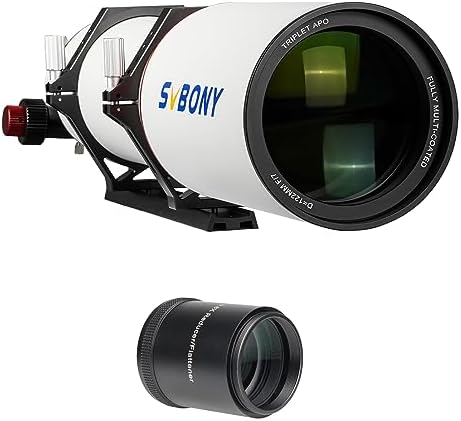
This bundle includes a 0.8X focal reducer field flattener designed specifically for prime focus astrophotography with the SV550 122mm f/7 apo refractor. It corrects the defect of field curvature, improving imaging quality and shooting efficiency of the edge of the field of view.
We may earn a commission when you buy through this link, at no additional cost to you.
The 122mm aperture gathers more light and offers clearer and detailed images suitable for deep sky photography. Due to the higher limiting magnitude, it is suitable for fainter deep sky objects which require more light-gathering power than smaller scopes provide.
The SV209 field flattener ensures that the entire sensor surface receives light correctly. While this kit is excellent for serious imagers, the combined weight and complexity require careful balancing on a mount to maintain tracking accuracy over long sessions.
For those wanting a complete solution for wide-field deep sky imaging, this kit is a strong contender. The inclusion of critical accessories like the focal reducer makes it ready for imaging right away, saving time on component research.
The 0.8X reducer shortens the effective focal length for wider fields of view without sacrificing optical quality.
Flattening the field ensures stars remain round from the center to the edges of your image sensor.
We may earn a commission when you buy through this link, at no additional cost to you.
This kit features the SV550 122mm APO refractor which is a compact refractor suitable for travel and observation. It uses a FPL-51 triplet apochromatic lens structure that contains one piece of ED glass to greatly reduce chromatic aberration and enhance clarity.
We may earn a commission when you buy through this link, at no additional cost to you.
The bundle includes the SV209 0.8X focal reducer field flattener designed for prime focus astrophotography. This accessory corrects the defect of field curvature of the user's shooting target, improving imaging quality and efficiency at the edges.
A portable handle and SV211 dovetail base allow the large-aperture telescope to be easily carried and moved. This makes the kit convenient for transport, though the overall weight still requires careful planning when traveling to dark sky locations.
Ideal for photographers who want a portable yet powerful aperture, this kit balances performance with mobility. The included accessories ensure you can start capturing detailed images without additional purchases.
With both the reducer and flattener included, this kit is ready for wide-field deep sky imaging right out of the box.
The integrated carrying handle on the dovetail base simplifies transport and setup at remote observing sites.
We may earn a commission when you buy through this link, at no additional cost to you.
This kit includes the SV550 80F6 OTA along with the SV209 field flattener, making it ready for imaging. The triple apochromatic optics structure improves the blue-edge chromatic aberration problem of single-ED structure imaging effectively.
We may earn a commission when you buy through this link, at no additional cost to you.
The sharp image provided by ultra wide band fully multilayer coated lens ensures bright and clear views. However, users should note that the image is inverted when used with an eyepiece, which is normal for astronomical refractors.
The SV209 is a special field flattener for the SV550 80F6 OTA, which can effectively improve the image quality problem of fringe field curvature. This combination ensures that stars remain round even at the edges of the frame.
The kit includes a comfortable and convenient carrying handle suitable for the SV550. This improves the safety factor of the product installation process and makes transporting the OTA much easier for observers.
Full multilayer coatings on double glass prevent reflections and ensure maximum light transmission for clear images.
The dedicated SV209 flattener is designed specifically for this OTA, ensuring optimal performance without guesswork.
We may earn a commission when you buy through this link, at no additional cost to you.
This bundle provides a complete guiding solution with the SV165 Mini Guide Scope and SV905C Telescope Camera. The SV905C is a compact and highly sensitive 1.23-megapixel color camera perfect for autoguiding or planetary imaging.
We may earn a commission when you buy through this link, at no additional cost to you.
The small 3.75-micron pixels and high peak QE of 80% allow tight tracking of faint guide stars. With low read noise, this camera ensures accurate guiding for long exposures, which is critical for capturing high-quality deep sky images.
Compatible with mainstream auto guiding cameras, it features a 1.25in and M42 mount interface. This design ensures compatibility with SV305 Pro and for Orion ZWO QHY and so on auto guiding cameras, though some models may require additional accessories.
For astronomers focused on precision tracking, this kit removes the hassle of sourcing guiding components separately. It is a solid addition to any imaging setup, ensuring that your main scope tracks accurately throughout the night.
The sensor's 80% peak quantum efficiency captures more light from faint guide stars for stable tracking.
Designed to work with mainstream camera interfaces, this guide setup fits easily into existing imaging systems.
We may earn a commission when you buy through this link, at no additional cost to you.
Selecting the right apochromatic refractor depends on your specific needs, whether for visual observation or astrophotography. Understanding these key factors will help you make an informed decision that matches your goals and budget.
Apochromatic refractors typically use a triplet or quadruplet design with low-dispersion glass to eliminate color fringing. Look for FPL-51 or FCD1 ED glass for superior color correction and sharpness across the entire field of view.
Always check the optical design type to ensure it meets your standards for color accuracy and image clarity.
Aperture determines how much light the telescope can gather, influencing how faint objects you can see. Larger apertures like 122mm offer better detail and light gathering but are heavier and more expensive than 80mm models.
Choose an aperture size that balances your desired light gathering with portability and budget constraints.
Focal ratio affects the field of view and exposure times. F/6 to F/7 scopes are versatile for both planetary and deep sky work, while faster scopes like F/5 are better for wide-field imaging.
Select a focal ratio that aligns with whether you prioritize wide-field views or detailed planetary shots.
A quality focuser with a dual-speed mechanism helps achieve precise focus for imaging. Look for focusers with a 1:10 ratio and sufficient travel to accommodate different cameras and accessories.
Ensure the focuser is robust enough to handle the weight of your imaging train without slipping.
The dovetail plate determines compatibility with mounts. Standard Vixen or Losmandy style plates are widely supported, ensuring you can attach the telescope to various equatorial or alt-azimuth mounts.
Check the dovetail type before purchasing to ensure it matches your existing mount setup.
Weight and size are critical for transport. Lighter scopes like the Askar 71F are easy to carry but may have less aperture. Heavier scopes offer better performance but require a sturdier mount.
Balance portability with performance based on whether you plan to travel frequently or set up in one location.
Bundles that include field flatteners or focal reducers save money and simplify setup. Verify exactly what is included to avoid buying extra parts later.
Prioritize kits that include necessary imaging accessories to reduce total setup cost.
Materials like magnesium alloy reduce weight while maintaining rigidity. Look for tubes with internal baffles or light traps to prevent stray light from affecting contrast.
Choose a scope with solid construction to ensure durability and better optical performance over time.
To get the best views, start by balancing your telescope on the mount and ensuring all locks are tightened before observing. Allow the optics to acclimate to the outdoor temperature to prevent dew and thermal tube currents.
Use a dew shield and heater if you plan to observe for long periods in humid conditions. This prevents dew from forming on the front lens which can ruin your views and damage the optics.
Store your telescope in a dry place and cover the objective lens when not in use. Regularly check collimation and clean the optics gently with proper lens cleaning solutions to maintain peak performance.
An apochromatic refractor uses special low-dispersion glass and multiple lens elements to correct for chromatic aberration. This results in sharper, color-free images compared to standard achromatic refractors which often show color halos around bright objects.
Yes, apochromatic refractors are excellent for astrophotography due to their flat fields and color correction. They are particularly suited for wide-field deep sky imaging because they produce sharp stars across the entire frame.
An 80mm aperture is often ideal for beginners as it balances portability and light gathering. This size is versatile enough for both planetary and deep sky viewing without being too heavy to handle easily.
Most refractors require a field flattener to ensure stars remain round at the edges of the frame. Some modern models like the Askar 71F come with self-flattened optics, so check the specific model's requirements before purchasing.
With proper care, refractor telescopes can last decades or even a lifetime. Unlike mirrors in reflectors, the sealed lenses do not need recoating, making them a durable investment for astronomy.
Yes, refractors are generally excellent for terrestrial viewing. However, be aware that astronomical models produce inverted images, so you may need an erecting prism if you intend to use it for land viewing.
APO refers to the lens design which corrects chromatic aberration to a high degree. ED refers to extra-low dispersion glass used within that design. High-quality APO scopes typically use ED glass like FPL-51 for the best results.
Most quality apochromatic refractors are factory aligned and do not require collimation. Some high-end models like the Explore Scientific ED80 have collimation screws for adjustments, but this is rarely needed for typical users.
We have reviewed ten outstanding apochromatic refractors ranging from the versatile SVBONY SV550 to the premium Explore Scientific ED80. Each model offers unique advantages depending on whether you prioritize portability, optical quality, or imaging accessories.
When selecting your telescope, consider your primary goals and the equipment you already own. Balancing aperture size with the stability of your mount is key to enjoying clear and steady views of the night sky.
Remember that product availability and prices may change, so always check current details on the retailer site before ordering. Happy stargazing and clear skies on your astronomical journey.