
2Pcs ADS1115 Module
5.0Editor score
Pack of two modules
Programmable gain amplifier
Low voltage supply range
This guide compares the top ten Arduino ADC boards for 2026, evaluating resolution, channel count, and interface options to help you choose the right data
Arduino projects often require measuring analog signals from sensors like thermocouples or load cells. Built-in converters lack precision, making external ADC boards essential for accurate data acquisition in robotics and monitoring systems.
We evaluated ten popular ADC modules based on resolution, sampling rate, channel count, and ease of integration. Our analysis focuses on compatibility with Arduino and Raspberry Pi, ensuring reliable performance for diverse electronic applications and data logging tasks.
Each pick highlights specific strengths such as precision, speed, or cost-effectiveness for your needs. While ratings reflect user feedback, note that prices and availability change frequently, so verify details before purchasing to ensure you get the best value.
5.0Editor score

4.7Editor score

4.6Editor score
This table provides a side-by-side comparison of all ten reviewed ADC boards, highlighting key specifications such as bit resolution, channel count, communication protocol, and supply voltage to help you quickly identify the best fit for your project requirements.




The Teyleten Robot ADS1115 module is a top choice for Arduino users needing precision analog conversion. It offers 16-bit resolution with four input channels, making it suitable for various sensor projects. Users praise its reliability and ease of use with both Arduino and Raspberry Pi.
We may earn a commission when you buy through this link, at no additional cost to you.
Its internal programmable gain amplifier allows measuring small signals effectively, while the I2C interface simplifies wiring. The wide supply voltage range ensures compatibility with different logic levels. Additionally, the pack of three provides spares for larger projects or team experiments.
While it cannot match high-speed converters, its data rate is sufficient for most sensor applications like temperature or voltage monitoring. The single-shot mode helps conserve power in battery-operated devices. Overall, it balances performance and cost exceptionally well.
This module is ideal for hobbyists and professionals building data loggers or monitoring systems. If you need accurate readings from low-voltage sensors, this ADC board delivers consistent results. We recommend it for anyone seeking a versatile and affordable solution.
The 16-bit resolution and PGA enable precise measurements from thermocouples and strain gauges without external amplification.
Operating from 2.0V to 5.5V ensures it works seamlessly with 3.3V and 5V microcontroller systems.
We may earn a commission when you buy through this link, at no additional cost to you.
The HiLetgo ADS1256 stands out for applications requiring extremely high precision. Its 24-bit resolution captures minute voltage changes, ideal for laboratory-grade measurements. The eight channels allow simultaneous monitoring of multiple signals, reducing the need for multiple modules.
We may earn a commission when you buy through this link, at no additional cost to you.
Built around a TI ADS1256 chip, it offers low nonlinearity and a stable onboard voltage reference. The SPI interface supports faster data rates up to 30ksps, suitable for dynamic signal acquisition. It can handle both single-ended and differential inputs flexibly.
While it needs a 5V supply and careful wiring, the performance justifies the effort. The high precision makes it valuable for industrial or scientific projects. Note that it measures signals within 3V typically, requiring attention to input ranges.
This board is best for advanced users needing top-tier accuracy. If your project involves detailed analysis or high-speed sampling, this module provides professional-grade performance. It is a premium choice for serious data acquisition tasks.
The 24-bit resolution and differential inputs enable capturing minute signal variations for scientific instrumentation.
Data rates up to 30ksps allow real-time monitoring of rapidly changing signals effectively.
We may earn a commission when you buy through this link, at no additional cost to you.
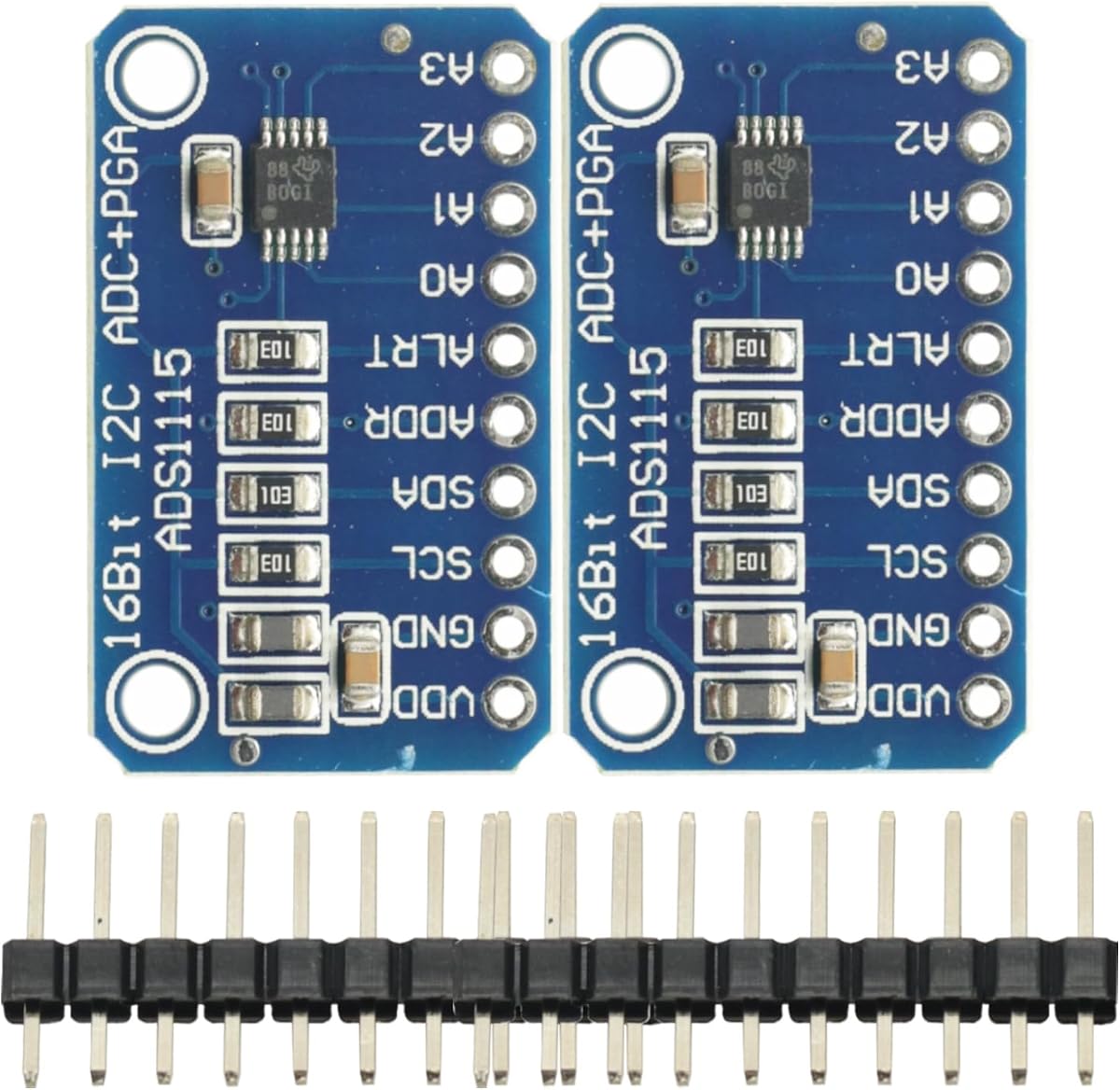
This listing offers two ADS1115 modules at a competitive price, making it excellent value for bulk projects. The 16-bit resolution ensures accurate readings, while the programmable data rate allows balancing speed and power. Users report high satisfaction with performance and reliability.
We may earn a commission when you buy through this link, at no additional cost to you.
The modules support various input voltage ranges, from small signals to full supply voltage. This flexibility is crucial for different sensor types. The I2C interface keeps wiring simple, and the programmable gain amplifier enhances sensitivity for low-voltage inputs.
While it is not designed for high-frequency signals, it performs exceptionally well for steady-state monitoring. The perfect rating reflects consistent quality and ease of integration. It is a practical choice for classrooms or multi-node networks.
Buy this if you need multiple ADC boards for a cost-effective solution. It suits most common Arduino and Raspberry Pi projects without compromising on precision. We recommend it for budget-conscious makers needing reliable performance.
Getting two modules ensures you have backups or can expand channels across multiple boards affordably.
Seven input range options let you tailor sensitivity to specific sensor output levels precisely.
We may earn a commission when you buy through this link, at no additional cost to you.
This pack provides three ADS1115 boards for extensive projects or classroom sets. It delivers standard 16-bit precision with programmable gain, ensuring accurate sensor data. The auto shut down mode helps manage power consumption in battery applications effectively.
We may earn a commission when you buy through this link, at no additional cost to you.
The wide supply range from 2.0V to 5.5V ensures compatibility across different hardware setups. Users note it is particularly useful for Raspberry Pi, which lacks native analog pins. The I2C interface makes adding multiple boards straightforward via addressing.
While the rating is slightly lower than others, it still represents solid quality for the price. Some users may find the individual board size small, requiring careful wiring. However, the functionality remains robust for standard data acquisition needs.
Ideal for group projects or those needing spares, this offer ensures you have enough boards for diverse experiments. It is a reliable option for educational or prototyping environments. We suggest verifying connections upon arrival to ensure all units work.
Auto shut down mode reduces power draw when sampling is not active, extending battery life.
Designed to fill the analog input gap on Raspberry Pi boards effectively for sensor projects.
We may earn a commission when you buy through this link, at no additional cost to you.
Four modules in one package make this ideal for large-scale sensor networks. Each ADS1115 offers 16-bit accuracy with programmable gain, ensuring quality data across all channels. Internal oscillators ensure stable timing without external components needed for operation.
We may earn a commission when you buy through this link, at no additional cost to you.
The ability to handle both differential and single-ended inputs provides flexibility for various sensor wiring. I2C communication simplifies integration, though managing addresses for four boards on one bus requires attention. Overall, it delivers consistent performance for multi-channel monitoring.
Users may find the rating reflects some variability in quality control, but it remains a functional choice. For projects requiring many inputs, this pack provides necessary quantity without prohibitive costs. It is suitable for industrial prototyping or extensive home automation.
We recommend this for setups needing many independent analog readings. Ensure proper I2C addressing to avoid bus conflicts. It is a practical solution for developers building complex monitoring systems on a budget.
Multiple units allow monitoring numerous sensors simultaneously across different locations or nodes.
Internal oscillators ensure consistent sampling rates without relying on external clock signals.
We may earn a commission when you buy through this link, at no additional cost to you.
This offering of two ADS1115 modules boasts a perfect rating, indicating high satisfaction. It provides 16-bit resolution and four input channels for versatile measurement tasks. The wide voltage input range ensures compatibility with various sensor outputs without extra circuits.
We may earn a commission when you buy through this link, at no additional cost to you.
Users appreciate the programmable data rate, allowing optimization for speed or power efficiency. Differential input support reduces noise interference from long sensor wires. The compact design fits easily into tight project enclosures or breadboards for efficient space use.
While I2C speed limits high-frequency applications, it suits most common monitoring needs. The modules are reliable and straightforward to integrate. This pack is a strong contender for hobbyists seeking quality without spending excessively on single units.
Buy this if you want a reliable pair of ADC boards for immediate projects. It is well-suited for home automation or environmental monitoring. We suggest checking connection pins carefully to ensure proper setup.
Differential input capability helps minimize electromagnetic interference in noisy industrial or outdoor environments.
Adjustable sampling rates let you trade off between measurement speed and power consumption as needed.
We may earn a commission when you buy through this link, at no additional cost to you.
Lonely Binary modules feature gold plating for improved solderability and durability. This three-pack is designed for C++ and ESP32 users but works with most I2C boards. The ENIG finish ensures reliable connections and oxidation resistance over time.
We may earn a commission when you buy through this link, at no additional cost to you.
Four selectable addresses allow chaining up to four modules on one bus for 16 channels. It supports both 3.3V and 5V logic, simplifying integration with diverse microcontrollers. Library support for MicroPython and CircuitPython adds flexibility for different programming styles.
While the price is a bit higher, the quality and finish justify the cost. It is especially useful for projects where reliability and long-term stability are priorities. The Australian design brand focuses on open-source friendly components.
We recommend this for users seeking a polished, reliable module for ESP32 or similar projects. It is ideal for educational or professional use where build quality matters. Ensure you have enough I2C pull-up resistors for chaining modules.
Gold plating ensures long-lasting, corrosion-free connections for durable project builds.
Compatible with UNO, ESP32, STM32, and others with C++ or Python library support.
We may earn a commission when you buy through this link, at no additional cost to you.
The AD7606 module targets applications needing fast, simultaneous sampling. With 200ksps and eight channels, it captures dynamic signals accurately. This is useful for audio or vibration monitoring where timing precision is critical. The 16-bit resolution ensures quality data even at high speeds.
We may earn a commission when you buy through this link, at no additional cost to you.
It supports wide input ranges like ±10V, making it versatile for industrial signals. Oversampling modes can improve effective resolution in specific conditions. However, the setup involves SPI communication and signal conditioning, which may be complex for beginners.
Users rate it lower likely due to integration challenges or niche performance. It is not a general-purpose board like the ADS1115 but serves specific high-speed needs well. Ensure your microcontroller can handle SPI at required clock speeds.
This module is best for specialized projects needing synchronized multi-channel acquisition. If you need fast sampling without sacrificing channels, this is a viable option. We recommend reading documentation carefully before starting integration.
200ksps sampling enables capturing fast-changing signals without aliasing or data loss.
Supports ±10V inputs directly, reducing need for signal conditioning circuits in industrial settings.
We may earn a commission when you buy through this link, at no additional cost to you.
This four-pack delivers reliable 16-bit conversion with consistent performance across units. High user satisfaction reflects stable quality and ease of integration. The integrated PGA enhances sensitivity, making it suitable for low-voltage sensors without external circuits.
We may earn a commission when you buy through this link, at no additional cost to you.
I2C interface keeps wiring simple, while compatibility with Arduino, ESP32, and STM32 ensures broad use. Each module handles four channels, so four boards provide extensive monitoring capacity. It is ideal for distributed sensor networks or classroom labs.
While limited by standard I2C speeds, it covers most common data logging scenarios effectively. Users find it easy to integrate into existing systems. The pack ensures you have enough modules for scaling up without separate purchases.
We recommend this for projects needing multiple ADC units. It balances quantity, quality, and usability well. Verify address configurations to avoid bus issues when connecting multiple modules simultaneously.
Multiple modules allow expanding monitoring coverage across large areas or complex setups easily.
Works well with temperature, pressure, and light sensors across various project types.
We may earn a commission when you buy through this link, at no additional cost to you.
This single unit represents the classic ADS1115 design trusted by many users. It provides 16-bit resolution with programmable gain for flexible measurement. The comparator mode allows threshold detection without continuous polling, saving processor cycles in applications.
We may earn a commission when you buy through this link, at no additional cost to you.
Wide supply voltage range ensures it works with 3.3V and 5V systems. The I2C interface simplifies connections. It is a staple for Raspberry Pi projects that lack analog inputs, enabling simple sensor data reading without additional converters.
While it does not offer high speed, it is robust for steady measurements. Users find it reliable for hobby and educational tasks. It serves as a reference point for evaluating other ADC modules in terms of performance and cost.
Buy this for standard projects needing accurate analog conversion. It is a solid, no-frills option for reliable performance. We recommend ensuring library compatibility with your specific microcontroller for smooth integration.
Allows setting thresholds to trigger events without constant polling, freeing up microcontroller resources.
Trusted design ensures predictable performance for a wide range of common sensor projects.
We may earn a commission when you buy through this link, at no additional cost to you.
Choosing the right ADC board depends on your specific measurement needs, available microcontroller resources, and budget. Consider resolution, channel count, communication protocol, and power requirements to ensure optimal performance for your project.
Resolution determines how finely the ADC can divide input voltage into digital values. Higher bit counts like 24-bit offer greater precision for sensitive sensors, while 16-bit suits most general applications. Select resolution based on the smallest signal changes you need to detect accurately.
Choose 16-bit for most projects and 24-bit for high-precision tasks.
The number of input channels affects how many sensors you can connect to one module. Boards with four or eight channels reduce the need for multiple devices. Ensure your chosen board provides enough inputs to avoid complex multiplexing.
Opt for more channels if monitoring multiple sensors simultaneously.
Interfaces like I2C and SPI determine wiring complexity and data speed. I2C uses fewer pins but is slower, suitable for steady readings. SPI is faster but requires more pins, ideal for rapid data acquisition. Match the interface to your microcontroller's capabilities.
Use I2C for simplicity and SPI for high-speed requirements.
Sampling rate indicates how many conversions per second the module can perform. Faster rates capture dynamic signals without aliasing. For slow sensors like thermocouples, standard rates are sufficient. Check if your application needs high-speed data logging.
Ensure the sampling rate matches your signal's frequency.
Different boards require different supply voltages, commonly 3.3V or 5V. Confirm your microcontroller's output voltage to avoid damage or signal errors. Some boards accept a wider range, adding flexibility for mixed-voltage projects.
Verify voltage compatibility with your power source.
A PGA allows measuring small signals by amplifying them before conversion. This feature is crucial for low-voltage sensors. Without it, you may lose detail in signals near zero volts. Ensure the ADC includes a PGA for sensitive measurements.
Prioritize boards with PGA for low-signal applications.
Ensure the ADC works with your microcontroller and operating environment. Some modules are optimized for specific boards like ESP32 or Raspberry Pi. Check library support to streamline software integration and reduce development time.
Check compatibility with your preferred hardware and libraries.
Budget influences your choice significantly. While premium boards offer more features, basic modules often suffice for most needs. Consider bulk packs for cost savings in larger projects. Verify availability to avoid delays in your development timeline.
Balance features with cost to get the best value.
Connect the ADC board to your microcontroller following the wiring diagram. Match SDA to SDA and SCL to SCL for I2C or MOSI/MISO for SPI. Ensure power and ground pins align to prevent electrical issues and damage to components.
Install the appropriate library for your board. Most ADC modules support Arduino IDE and include example sketches. Configure the library settings such as data rate and input range to match your sensor specifications accurately.
Calibrate your system by comparing readings with a known voltage source. Protect the board from moisture and dust using enclosures. Regularly check connections to ensure consistent performance and extend the lifespan of your ADC modules.
An ADC board converts analog signals from sensors into digital data that the Arduino can process. Since Arduino boards have limited or no analog inputs, external ADCs enable reading temperature, light, or voltage signals precisely.
Yes, you can connect multiple ADC boards using different I2C addresses. Each board has a unique address allowing up to four on the same bus. This setup expands your available analog channels significantly.
I2C uses fewer wires and is simpler for small projects. SPI offers faster data transfer suitable for high-speed sampling. Your choice depends on your wiring constraints and data rate requirements.
Choose 16-bit for standard sensor readings and 24-bit for extremely high precision. 24-bit boards are more expensive and complex but capture minute signal changes effectively.
Most ADC boards require a specific library for communication and configuration. Always check documentation for compatible libraries. Using standard libraries simplifies integration and reduces errors in your code.
Check the board's specifications for supply voltage. Many support 3.3V to 5V, but some require fixed 5V. Ensure your microcontroller matches to avoid damage and signal errors.
We reviewed ten top Arduino ADC boards, ranging from versatile 16-bit modules to high-speed 24-bit boards. The Teyleten ADS1115 and ADS1256 lead in performance and precision for most applications.
Prioritize resolution and channel count based on your sensors and budget. For most hobbyists, a 16-bit I2C module offers the best balance of cost and functionality.
Prices and availability change quickly, so verify current listings before purchasing. This guide helps you find the right ADC board to bring your projects to life.