
Zoom H1 XLR 2-Channel Recorder for Filmmakers, Musicians & Podcasters
4.5Editor score
Two XLR/TRS inputs
32-bit / 96kHz
OLED waveform display
Compare the top audio field recorders for film to find the best model for your production needs, features, and budget in this comprehensive expert guide.
Audio field recorders are essential tools for filmmakers who demand pristine sound quality on set. Whether capturing dialogue, ambient noise, or music, the right device ensures your project sounds professional and polished for any audience.
We evaluated ten leading recorders based on input flexibility, recording fidelity, timecode support, and portability. Our analysis covers handheld units, multi-track mixers, and specialized devices designed for run-and-gun or controlled studio environments.
Each selection highlights unique strengths, from 32-bit float recording to rugged construction. Prices and availability change frequently, so verify current details before purchasing to ensure you get the best value for your specific workflow.
4.5Editor score

4.7Editor score
4.6Editor score
This side-by-side comparison highlights the core capabilities of each recorder, helping you quickly identify which unit matches your production scale and technical requirements.



The Zoom F3 is built for professionals who need a recorder they can trust in the field. With a strong 4.6 rating, it excels at capturing everything from quiet dialogue to sudden peaks without manual level adjustments.
We may earn a commission when you buy through this link, at no additional cost to you.
Its 32-bit float recording ensures your audio never clips, while dual locking XLR inputs keep connections secure during complex rig setups. Ultra-low-noise preamps maintain clean sound even in unpredictable environments.
While it lacks timecode syncing and has fewer inputs than larger models, the F3 prioritizes simplicity and reliability. These trade-offs are acceptable for run-and-gun filmmakers who need a robust core recorder.
Buy this if you value dependable performance in a compact form. It is the ideal companion for on-location shoots where audio quality cannot be compromised by equipment failure.
Dual locking XLR inputs ensure your microphones stay connected even when the recorder is mounted out of reach.
Flexible power options allow you to keep recording without interruption, whether using batteries or USB.
We may earn a commission when you buy through this link, at no additional cost to you.
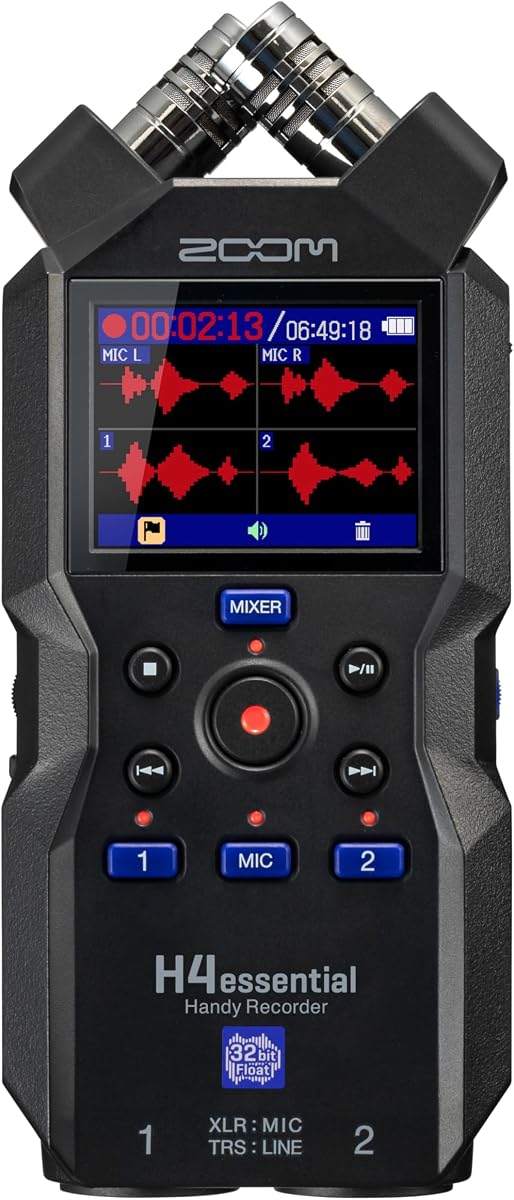
The Zoom H4 Essential is a versatile 4-track recorder designed to capture bigger projects with confidence. Its 4.4 rating reflects its ability to handle music, interviews, and video audio without distortion.
We may earn a commission when you buy through this link, at no additional cost to you.
You can plug in external mics or connect to soundboards via two XLR/TRS inputs, ensuring clear sound for creative work. The unit also allows simultaneous recording to SD card and USB-C device connection.
While its menu guidance aids visually impaired users, the unit is slightly bulkier than simpler models. This weight is acceptable given the expanded input flexibility and track options it offers.
This recorder suits creators who need more than stereo capture. It bridges the gap between basic handhelds and professional mixers, making it ideal for podcasters and filmmakers alike.
Connect external mics, instruments, or mixers with two XLR/TRS inputs for expanded recording setups.
Save backups directly to SD card while connecting to your device via USB-C for peace of mind.
We may earn a commission when you buy through this link, at no additional cost to you.
With a 4.7 rating, the Zoom F6 is a top-tier choice for filmmakers needing massive dynamic range. Its 32-bit float recording handles whispers to explosions without clipping, ensuring pristine takes every time.
We may earn a commission when you buy through this link, at no additional cost to you.
Six XLR inputs and up to 14 tracks provide full production flexibility, while timecode I/O keeps audio synced to video. The rugged design makes it reliable for location work without sacrificing portability.
Its price is higher than entry-level units, but the professional features justify the investment. The trade-off is manageable for crews who need frame-accurate sync and robust channel options.
Invest in this recorder for broadcast or demanding film sets. It delivers the control and fidelity required for high-end production workflows.
Timecode I/O ensures your audio is perfectly synced with video for filmmaking and broadcast.
Use the F6 as a standalone recorder or a USB audio interface for full control in any setup.
We may earn a commission when you buy through this link, at no additional cost to you.
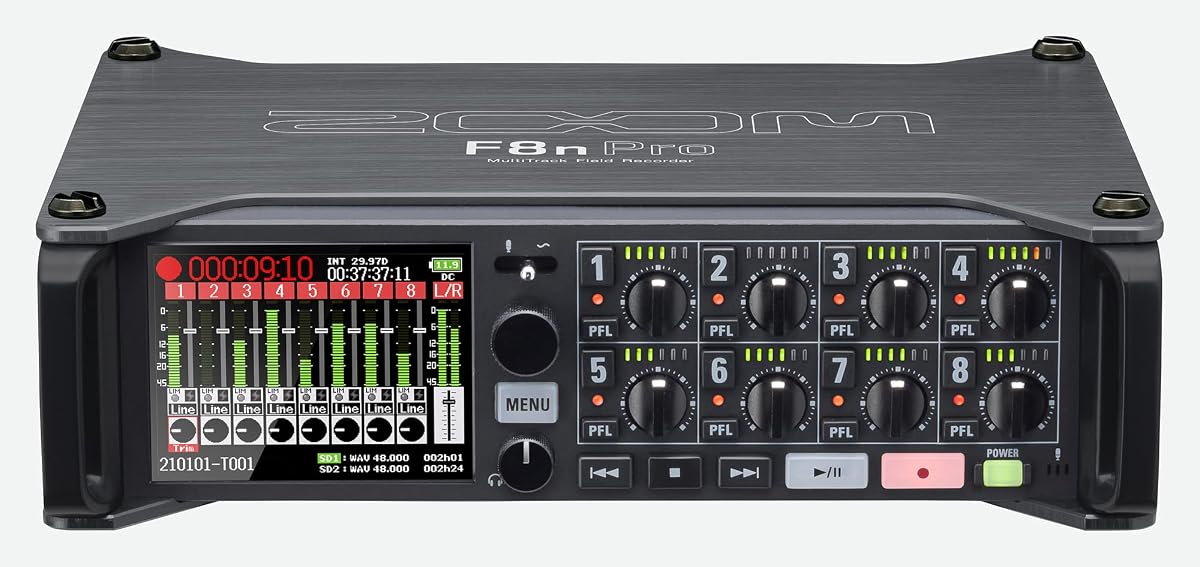
The Zoom F8n Pro is the choice for professional film and field audio, earning a 4.6 rating for its reliability. It captures clip-free audio across the full dynamic range with high-quality preamps.
We may earn a commission when you buy through this link, at no additional cost to you.
Features like 0.2ppm timecode accuracy and dual SD slots with redundant recording ensure you never miss a critical take. It can also function as an 8-in/4-out USB audio interface while recording to cards.
Its advanced capabilities come with a steep learning curve and higher cost. However, for full production workflows, these features are essential for maintaining broadcast-quality standards.
Choose this recorder if you are leading a professional crew. It provides the ultimate flexibility and safety needed for complex shoots.
Dual SD card slots allow redundant recording, so your audio is safe even if one card fails.
Industry-leading timecode accuracy keeps your tracks perfectly aligned with picture on or off set.
We may earn a commission when you buy through this link, at no additional cost to you.
The Zoom H1 XLR delivers pro-quality results with simple setup, earning a strong 4.5 rating. It records in 32-bit / 96kHz, making it perfect for interviews, podcasts, and everyday recording.
We may earn a commission when you buy through this link, at no additional cost to you.
Two XLR/TRS combo inputs let you connect various sources flexibly, while the OLED display ensures you always know your levels. SDXC support up to 1TB gives you ample space for extended sessions.
It lacks advanced timecode or multi-track capabilities, but these trade-offs are acceptable for solo creators. The price point makes professional-grade audio accessible to everyone.
Buy this recorder for versatile, reliable daily use. It is an excellent choice for those starting out or needing a quick, high-quality capture device.
The OLED waveform display makes it easy to monitor levels and ensure clean recordings at a glance.
Support for SDXC cards up to 1TB provides plenty of space for high-quality, long recordings.
We may earn a commission when you buy through this link, at no additional cost to you.
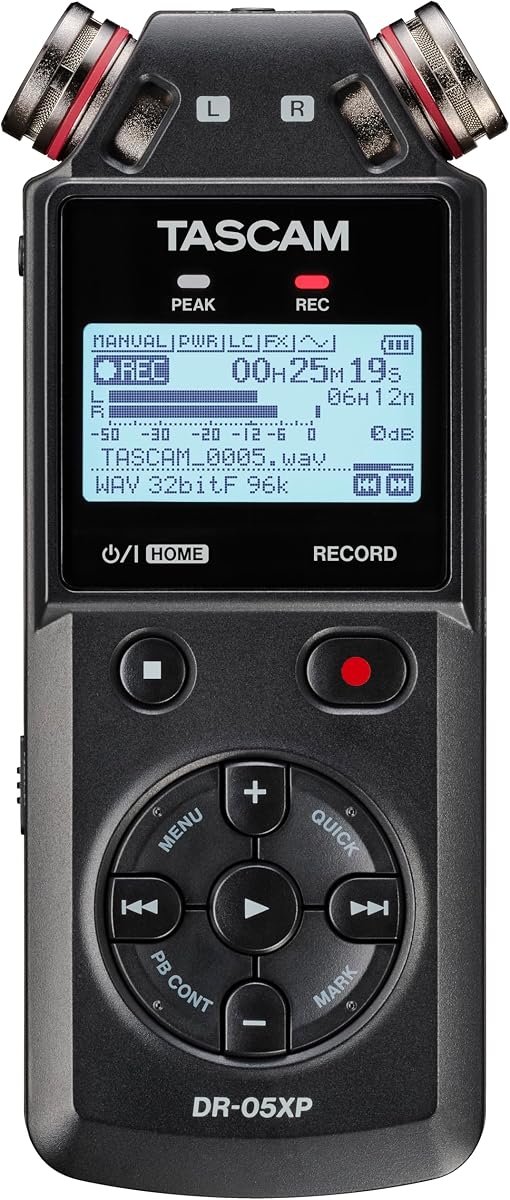
The TASCAM DR-05XP makes it easy to capture pro-quality recordings for music and audio-for-video. It features flexible modes including 32-bit float and handles loud sources up to 125dB SPL.
We may earn a commission when you buy through this link, at no additional cost to you.
Its omnidirectional condenser mics work well in various environments, and the 2-in/2-out USB-C interface allows direct recording to your computer. It offers up to 17.5 hours of operation on AA batteries.
The lack of external XLR inputs limits its use for dedicated microphone setups. However, for quick handheld recording, this compact size and long battery life are significant advantages.
Ideal for journalists or content creators needing a quick, lightweight solution. It simplifies the process of getting clean audio without bulky gear.
Up to 17.5 hours of operation with AA batteries ensures you can record throughout a full day.
The 2-in/2-out USB-C audio interface allows for easy recording directly to your computer.
We may earn a commission when you buy through this link, at no additional cost to you.
The Zoom H5 uses a system of interchangeable input capsules that swap out easily. It includes a detachable X/Y capsule with shock-mounted mics to reduce handling noise.
We may earn a commission when you buy through this link, at no additional cost to you.
Four-track simultaneous recording and two mic/line inputs with selectable phantom power make it highly versatile. It runs on AA batteries and records directly to SD or SDHC cards up to 32GB.
Its reliance on AA batteries and 32GB card limit might be restrictive for long shoots. However, the flexibility of changing capsules makes it a favorite among versatile creators.
This recorder is perfect for those who need to adapt quickly. The ability to change capsules allows for different recording scenarios with one main device.
Interchangeable capsules allow you to swap input types as easily as changing a camera lens.
Multichannel and stereo USB audio interface with Loop Back function for flexible desktop recording.
We may earn a commission when you buy through this link, at no additional cost to you.
The DR-10L Pro features LTC Jam Sync for seamless timecode synchronization in multi-device setups. Its 32-bit float recording captures everything from a whisper to a scream with fidelity.
We may earn a commission when you buy through this link, at no additional cost to you.
A high-capacity microSDXC card support ensures endless storage. The included TM-10L lavalier microphone is perfectly matched to deliver clear, lifelike audio even in busy settings.
As a body-worn unit, it limits multi-mic setups. However, its stealth and sound quality make it ideal for personal interviews and discreet recording situations.
Choose this for personal audio needs where timecode sync is critical. It delivers professional results in a compact, wearable format.
LTC Jam Sync support allows for streamlined post-production workflows for filmmakers.
The included lavalier microphone ensures clear audio in busy settings like receptions.
We may earn a commission when you buy through this link, at no additional cost to you.
The Zoom H1 Essential captures clear stereo audio perfect for videos, tutorials, and voiceovers. It allows you to create content with better sound using simple, intuitive controls.
We may earn a commission when you buy through this link, at no additional cost to you.
With USB-C connectivity, it serves as a microphone for livestreams and remote meetings. It records sound easily in the moment, making it ready when inspiration hits.
While it lacks the advanced features of higher-end models, it is designed for simplicity. The trade-off is acceptable for content creators prioritizing ease of use over professional specs.
Buy this for polished sound without complexity. It is an excellent tool for creators needing quick, high-quality audio for digital content.
Record sessions and lessons with detailed sound that is easy to capture in the moment.
Capture ambience, nature, and voiceovers effortlessly for various creative projects.
We may earn a commission when you buy through this link, at no additional cost to you.
The Zoom F2 is the smallest 32-bit float recorder you can wear, capturing clip-free audio without gain adjustments. It comes with a Lavalier microphone ready to go for interviews or vlogs.
We may earn a commission when you buy through this link, at no additional cost to you.
Running up to 15 hours on two AAA batteries makes it one of the most power-efficient options. Its precision clock ensures perfect audio and video sync for professional production.
It is designed strictly for wearable applications. The trade-off is acceptable for creators who need discrete, high-fidelity personal recording solutions.
Select this for discreet, on-camera recording. It simplifies the process of capturing clean audio without bulky external gear.
Clip-on lavalier microphone with screw-lock connector for secure placement during recordings.
Precision internal clock ensures perfect audio and video sync for film and video.
We may earn a commission when you buy through this link, at no additional cost to you.
Selecting the right field recorder depends on your production needs, input flexibility, and desired sound quality.
Look for recorders with sufficient XLR inputs to match your microphone setup. Some units allow for multi-mic arrays while others are designed for stereo recording.
Ensure the input count meets your daily production demands to avoid compatibility issues.
32-bit float technology is highly recommended as it prevents clipping and captures extreme dynamic ranges. This ensures your audio remains clean even when levels spike unexpectedly.
Choose units that support this format for the highest possible audio quality and safety.
Professional production requires precise synchronization between audio and video. Recorders with timecode inputs or built-in generators ensure seamless editing.
Verify that the recorder supports industry-standard timecode protocols for your workflow.
Field recorders should be rugged enough to withstand location demands yet lightweight enough to carry comfortably. Consider size, weight, and battery life for extended shoots.
Balance durability with ease of transport to maintain efficiency on set.
Check whether the unit supports USB-C power delivery or requires AA batteries. Long recording sessions benefit from flexible power options like external power banks.
Confirm compatibility with your existing power accessories to avoid interruptions.
High-resolution audio files consume significant space. Ensure the recorder supports large capacity SD cards like SDXC up to 512GB or 1TB.
Sufficient storage allows you to record continuously without interruption during a shoot.
USB-C connectivity enables streaming and direct device connection for backups. This feature is vital for modern workflows requiring immediate file access.
Select recorders that support versatile connectivity options to streamline your process.
Professional features like timecode and float recording come at different price points. Determine your essential features versus optional ones to stay within budget.
Invest in a recorder that offers the best value for your specific needs without overspending.
Start by calibrating your recorder settings according to your microphone types and environment. Adjust gain levels carefully or use float recording to avoid clipping during loud moments.
Always monitor audio levels using the built-in waveform display or headphones. This helps catch issues early and ensures your recording remains clear throughout the shoot.
Care for your equipment by storing it in a protective case and cleaning the XLR ports regularly. Proper maintenance extends the life of your recorder and ensures consistent performance.
32-bit float recording allows you to capture audio across a massive dynamic range without clipping. This technology ensures that quiet whispers and loud noises are recorded clearly, making it ideal for unpredictable environments.
While cameras can record audio, field recorders offer higher quality preamps, better dynamic range, and flexibility. They also allow for multi-track recording and independent monitoring not usually available on cameras.
You can use timecode generators or software-based syncing tools like PluralEyes. Many field recorders have built-in timecode inputs to streamline this process for professional workflows.
Field recorders typically support XLR microphones including condenser, dynamic, and lavalier types. Some models also accept 3.5mm inputs for smaller or portable mics.
Audio files can take significant space depending on quality. For long shoots, SD cards up to 512GB or 1TB are recommended to avoid running out of space mid-production.
Yes, field recorders excel at recording interviews and podcast episodes. They provide clarity and multi-track options that enhance voice quality and post-production flexibility.
Our top picks include the Zoom F6 and F8n Pro for professional needs, the Zoom H1 XLR for budget-conscious creators, and the TASCAM DR-10L Pro for wearable solutions.
Prioritize features like 32-bit float, timecode support, and input flexibility based on your production requirements to get the best value and performance.
Always check current prices and availability before purchasing as deals change frequently. Selecting the right tool ensures your project sounds as professional as it looks.