
AGFRC 20A BLHeli_S DSHOT600 ESC
4.3Editor score
DShot600 digital protocol support
Compact lightweight design
Multiple throttle signal modes
This guide compares the top ten electronic speed controllers for racing quadcopters to help you find the most efficient and reliable ESC for your FPV build.
Choosing the right electronic speed controller is critical for any racing quadcopter build. High quality ESCs ensure smooth motor control and efficient power delivery which directly impacts flight performance and reliability during intense maneuvers.
We evaluated ten top rated ESCs based on their amperage ratings, supported protocols, and build quality. Our comparison focuses on models that offer the best balance of performance and value for FPV racing and freestyle applications.
Each pick highlights key features and potential tradeoffs to help you decide. Remember that prices and availability can change frequently so always verify the latest details before making your final purchase decision online.
4.3Editor score
4.4Editor score

The following table provides a side by side comparison of all ten ESCs to help you quickly identify the best match for your specific racing quadcopter requirements and build constraints.




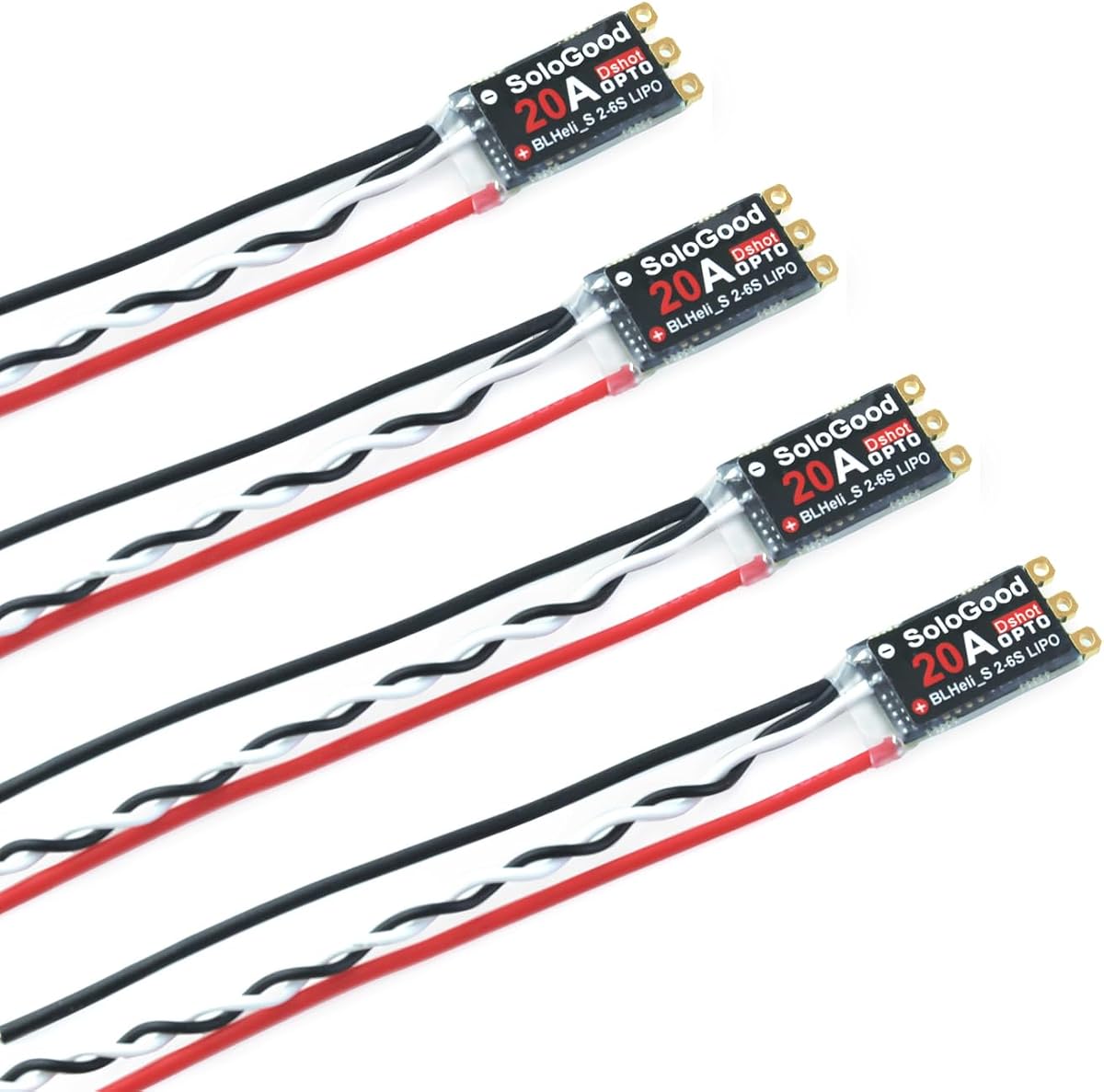
This ESC pack stands out as a top choice for FPV quadcopters thanks to its reliable BLHeli_S firmware and solid build quality. With a 4.4 rating from users it delivers consistent performance across various racing builds.
We may earn a commission when you buy through this link, at no additional cost to you.
The twisted pair throttle signal cable reduces crosstalk effectively ensuring cleaner transmission signals during flight. It also supports multiple digital protocols which makes it versatile for different flight controllers and receiver setups.
While it is optimized for 2-4S batteries this limits high voltage setups. However for standard racing drones this is rarely an issue. The smooth speed control feel is particularly appreciated by pilots looking for precision.
Overall this ESC is an excellent choice for builders seeking a balance of performance and reliability. It is highly recommended for anyone constructing a standard FPV racing quadcopter where consistent throttle response is key.
The twisted pair design of the throttle signal cable minimizes electromagnetic interference and crosstalk which ensures smoother and more reliable motor control during high frequency operations.
Support for DShot and BLHeli_S protocols allows pilots to fine tune their motor performance easily and integrate with most modern flight controllers without compatibility issues.
We may earn a commission when you buy through this link, at no additional cost to you.
The LittleBee ESC is designed specifically for tight racing builds where space is at a premium. Its compact 23x12x4mm footprint allows it to integrate seamlessly into small frame designs without adding bulk.
We may earn a commission when you buy through this link, at no additional cost to you.
It comes preloaded with BLHeli_S firmware which simplifies setup and ensures reliable performance out of the box. The DShot protocol support provides fast responsive digital signals essential for high speed racing.
Muted mode offers quieter operation which can be beneficial for certain racing environments. However the lack of rating data makes it slightly less predictable than other options with established track records.
This ESC is ideal for pilots prioritizing weight and size in their quadcopter builds. If you need a lightweight reliable solution that fits tight spaces this LittleBee ESC is a strong candidate.
Its extremely small dimensions make it perfect for micro racing drones where every gram and millimeter counts towards achieving optimal agility and speed on the course.
With preloaded BLHeli_S firmware and bootloader users can start flying immediately without needing to flash or configure the ESC manually saving time during the build process.
We may earn a commission when you buy through this link, at no additional cost to you.
The HGLRC 60A 6S V1 ESC offers significant power headroom with a 60A 4-in-1 design that supports up to 6S batteries. This makes it suitable for high performance freestyle and racing setups.
We may earn a commission when you buy through this link, at no additional cost to you.
Immersion gold plating enhances durability and resistance to heat and current spikes ensuring stable output over time. Large pads allow for direct plug-in connection to flight controllers simplifying installation.
While it eliminates soldering hassles it requires a specific 4-in-1 layout which may not fit all frame configurations. Still the high power and stable output make it a solid choice for demanding builds.
This ESC is best for pilots needing robust power delivery for larger motors or higher battery voltages. If your quadcopter demands 6S capability and reliable heat resistance this model delivers well.
The immersion gold design protects against high temperatures and current stress which extends the lifespan of the ESC during intense racing sessions and continuous high load usage.
Direct plug-in pads eliminate the need for soldering wires to the flight controller reducing assembly time and potential connection errors for builders of all experience levels.
We may earn a commission when you buy through this link, at no additional cost to you.
The MAD AMPX 40A Pro ESC receives a perfect 5.0 rating highlighting its exceptional reliability and performance in real world testing. It brings new core software that enhances throttle response significantly.
We may earn a commission when you buy through this link, at no additional cost to you.
Intelligent adaptive default settings like auto-adjusting timing ensure compatibility with a wide range of applications without requiring manual tuning. This makes it accessible for both beginners and experienced pilots.
Its signal frequency support above 600Hz and crosstalk reduction contribute to smoother control. However it is limited to 40A continuous current which may not suffice for the largest setups.
For quadcopter builds needing precise control without complex tuning this ESC is a top contender. Its intelligent features and high user satisfaction make it a trustworthy option for racing.
The auto-adjusting timing feature automatically optimizes motor performance based on load conditions providing peak efficiency and response across a broad range of flight scenarios.
Advanced crosstalk reduction technology ensures that throttle signals remain clear and stable even in electrically noisy environments which is critical for maintaining precise drone control.
We may earn a commission when you buy through this link, at no additional cost to you.
The AGFRC XR-20A ESC offers exceptional value for budget conscious builders without compromising on essential performance features. Its 4.3 rating reflects solid reliability for standard FPV racing drones.
We may earn a commission when you buy through this link, at no additional cost to you.
Hardware PWM drive and Damped light enable smooth throttle response and reduced motor speed noise. The compact size makes it easy to install in tight frames common in racing quads.
Support for multiple signal modes like DShot600 and PWM provides flexibility. However the 20A limit means it is best suited for smaller motors typically used in lightweight racing configurations.
This ESC is an ideal starting point for new pilots or those on a tight budget. It delivers the core capabilities needed for responsive racing flight without unnecessary extra cost.
Damped light technology allows for faster and more precise throttle transitions which improves agility and control accuracy during rapid maneuvers and high speed racing segments.
Despite its low price point this ESC maintains quality components and firmware support ensuring dependable performance for competitive flying without breaking the bank.
We may earn a commission when you buy through this link, at no additional cost to you.
The SEQURE E160 G2 ESC is a premium powerhouse designed for heavy duty FPV drones requiring maximum power and efficiency. Its 160A continuous current capacity ensures optimal power delivery under extreme loads.
We may earn a commission when you buy through this link, at no additional cost to you.
It features a built-in ammeter that transmits telemetry data in real time including motor speed and temperature. This allows pilots to monitor performance and prevent overheating during extended flights.
The large metal heat sink enhances heat dissipation ensuring stable high-power output. While its weight and cost are significant it is unmatched for high-end racing builds demanding top tier performance.
This ESC is best for pilots building large racing quads that demand robust power handling. If telemetry and peak performance are priorities this premium ESC is worth the investment.
The built-in ammeter provides critical flight data such as current and temperature enabling pilots to make informed decisions and prevent thermal throttling or power loss.
A large metal heat sink ensures efficient heat dissipation allowing the ESC to maintain consistent performance even during prolonged high-throttle racing sessions.
We may earn a commission when you buy through this link, at no additional cost to you.
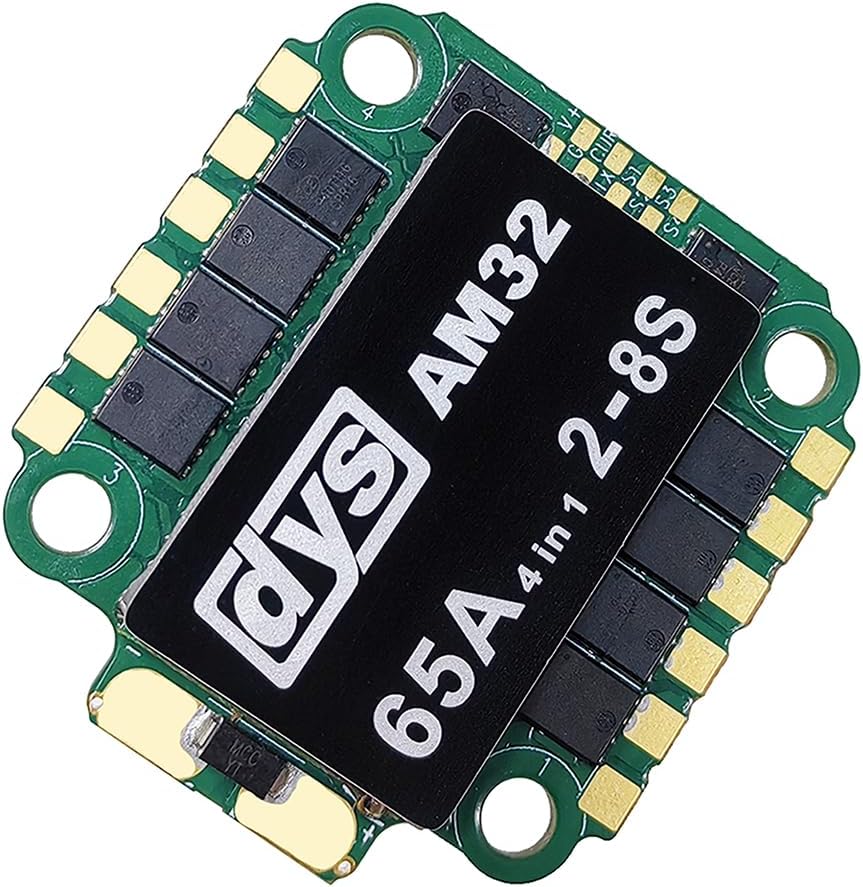
The DYS Brushless ESC features AM32 firmware which offers advanced tuning capabilities for experienced pilots. With a 65A rating and 2-8S support it handles a wide range of motor and battery configurations.
We may earn a commission when you buy through this link, at no additional cost to you.
The 32-bit processor ensures precise control and robust performance. Upgraded MOSFETs provide a 15 percent performance improvement over previous generations enhancing efficiency and responsiveness.
However its low rating of 2.9 suggests inconsistent performance or quality control issues. Users should expect potential trade-offs between features and reliability compared to more established models.
This ESC is suitable for those willing to experiment with AM32 features and tolerate possible quirks. If you prioritize firmware flexibility over consistent ratings this model might be worth exploring.
AM32 firmware provides extensive customization options and real-time telemetry that allow advanced users to fine-tune motor performance for specific racing conditions.
Upgraded MOSFETs deliver a 15 percent performance boost improving power efficiency and reducing heat generation during high load operations on FPV drones.
We may earn a commission when you buy through this link, at no additional cost to you.
The SEQURE AIO Stack combines a 70A ESC with a high-end flight controller offering a complete solution for complex builds. It supports up to 8 motors and 2-8S batteries for versatile racing quadcopters.
We may earn a commission when you buy through this link, at no additional cost to you.
Dual BEC outputs provide independent power for DJI O3 and analog systems simplifying wiring and reducing clutter. The STM32H743 processor ensures fast processing and data recording capabilities.
Its angled solder pads reduce welding difficulty which is a nice touch for custom builds. However the 3.3 rating indicates some users may face compatibility or reliability issues during setup.
This stack is best for pilots wanting a clean integrated setup without separate ESC and FC purchases. It suits those who prioritize reduced wiring and advanced flight features in one package.
Combining ESC and flight controller into one stack reduces wiring complexity and saves space making it ideal for complex racing builds like octocopters.
Advanced MCU processors and onboard barometers ensure precise flight data recording and stable control even during aggressive racing maneuvers.
We may earn a commission when you buy through this link, at no additional cost to you.
The Radiolink FLYCOLOR 55A ESC delivers smooth motor control with hardware generated PWM to reduce noise and improve throttle response. Its 4.4 rating reflects solid performance in racing applications.
We may earn a commission when you buy through this link, at no additional cost to you.
Operating at up to 50MHz it provides precise timing for motors. Support for both Bluejay and BLHeli-S firmware ensures flexibility for different user preferences and receiver protocols.
While its dimensions and weight suit high-speed racing quads well it caps at 6S which may limit high voltage setups. Still the hardware advantages make it a reliable mid-range option.
This ESC is recommended for pilots seeking low noise and precise control without premium pricing. It fits well into high-speed racing builds where reliability and smoothness are valued.
Hardware generated motor PWM reduces acoustic noise significantly which helps in minimizing distractions during flight and improves sensor accuracy in noisy environments.
Support for both Bluejay and BLHeli-S firmware allows users to choose their preferred control logic and protocol features based on their specific flight controller setup.
We may earn a commission when you buy through this link, at no additional cost to you.
The SEQURE 65A AM32 ESC combines 32-bit processing with a multi-layer PCB to deliver efficient power conversion and heat dissipation. Its PWM frequency supports up to 96KHz for fast motor response.
We may earn a commission when you buy through this link, at no additional cost to you.
The AT32F421 processor enables smooth performance and reliable telemetry support. Standard 30.5mm mounting holes make it compatible with most racing frames simplifying installation and upgrades.
While it offers good specs the 3.5 rating suggests room for improvement in consistency. Still for pilots seeking AM32 features at a mid-range price this is a viable option.
This ESC is best for those wanting modern AM32 benefits without premium costs. It suits balanced racing builds that need solid power handling and efficient thermal management.
Multi-layer PCB design increases over-current capability and reduces heat buildup allowing the ESC to maintain stable output during intense racing conditions.
Support for PWM frequencies up to 96KHz ensures rapid motor response and smooth control which is essential for precise racing maneuvers and high-speed flight.
We may earn a commission when you buy through this link, at no additional cost to you.
Selecting the right ESC involves understanding key technical factors that impact flight performance and reliability.
The amperage rating indicates the maximum current the ESC can handle safely. For racing quadcopters choose a rating that matches or exceeds your motor's peak current draw to avoid overheating or failure during high-throttle maneuvers.
Always pick an ESC with at least a 20 percent margin above your motor's rated current for safety and longevity.
Modern ESCs support protocols like DShot, Oneshot, and PWM. DShot offers digital precision and reduced noise so verify your flight controller supports the protocol you plan to use for best compatibility.
Prioritize DShot600 or higher for smoother throttle control and better telemetry feedback.
Firmware like BLHeli_S or AM32 determines tuning options and features. BLHeli_S is widely supported and easy to flash while AM32 offers advanced telemetry. Choose based on your comfort level with configuration.
BLHeli_S is ideal for most racers needing reliable performance without complex setup.
Ensure the ESC supports your battery voltage range. 2-4S is standard for many racing quads but higher voltage setups need ESCs rated for 6S or more to prevent power loss or damage.
Check the input voltage range carefully to match your battery configuration exactly.
ESC size must fit within your frame's motor mount spacing. Common sizes include 30.5mmx30.5mm for 4-in-1 ESCs. Measure your frame before buying to avoid mounting conflicts and extra weight.
Compact designs help reduce overall weight and improve quadcopter agility.
Quality ESCs include heat sinks or thick PCBs to dissipate heat. Racing generates significant heat so look for metal cases or multi-layer PCB designs to prevent thermal throttling during long flights.
Superior thermal design ensures consistent performance over extended racing sessions.
Many ESCs have integrated plugs or open wire ends. Solderless connectors save time but open wires offer flexibility. Select based on your soldering skill and desired setup speed.
Pre-soldered connectors are convenient but ensure they match your power distribution board.
Check user reviews for reliability insights. A high average rating often indicates consistent quality. Avoid models with frequent failure reports regardless of specs to ensure flight safety.
Prioritize ESCs with proven track records in FPV racing communities.
Install the ESC securely within the frame ensuring proper ventilation to prevent overheating during use. Secure all wires to avoid entanglement with propellers.
Calibrate the ESC before every flight by following your flight controller's instructions to ensure accurate throttle response and motor alignment.
Inspect the ESC regularly for signs of wear or heat damage and clean dust from cooling vents to maintain optimal performance over time.
BLHeli_S is widely supported and offers basic tuning features ideal for standard racing setups. AM32 provides advanced telemetry and customization but requires more configuration experience for optimal use.
Match the ESC's continuous amperage to your motor's peak current draw plus a 20 percent safety margin. This ensures the ESC can handle high-throttle bursts without overheating during races.
DShot offers digital signals that are faster and more reliable than analog PWM. This reduces noise and improves throttle precision which is critical for high-speed racing performance.
Technically yes but it is inefficient and adds unnecessary weight. Using a single ESC for single motor setups is better for weight savings and power efficiency in racing builds.
Update firmware when new features or fixes are released that benefit your setup. Avoid updating unnecessarily as it can introduce instability if the new version is not fully tested.
Most racing quadcopters use 4S LiPo batteries for a balance of power and weight. Higher voltage setups require ESCs rated for 6S to ensure safe operation and prevent damage.
The top picks in this guide highlight the best budget and premium ESCs for racing quadcopters based on performance and value. Each option brings unique strengths suited to different build requirements.
Prioritize amperage capacity and protocol support to ensure your ESC meets the demands of high-speed racing without compromising reliability or safety during intense flight sessions.
Always check current availability and verify compatibility with your specific flight controller before purchase to guarantee smooth integration and optimal performance for your FPV quadcopter.