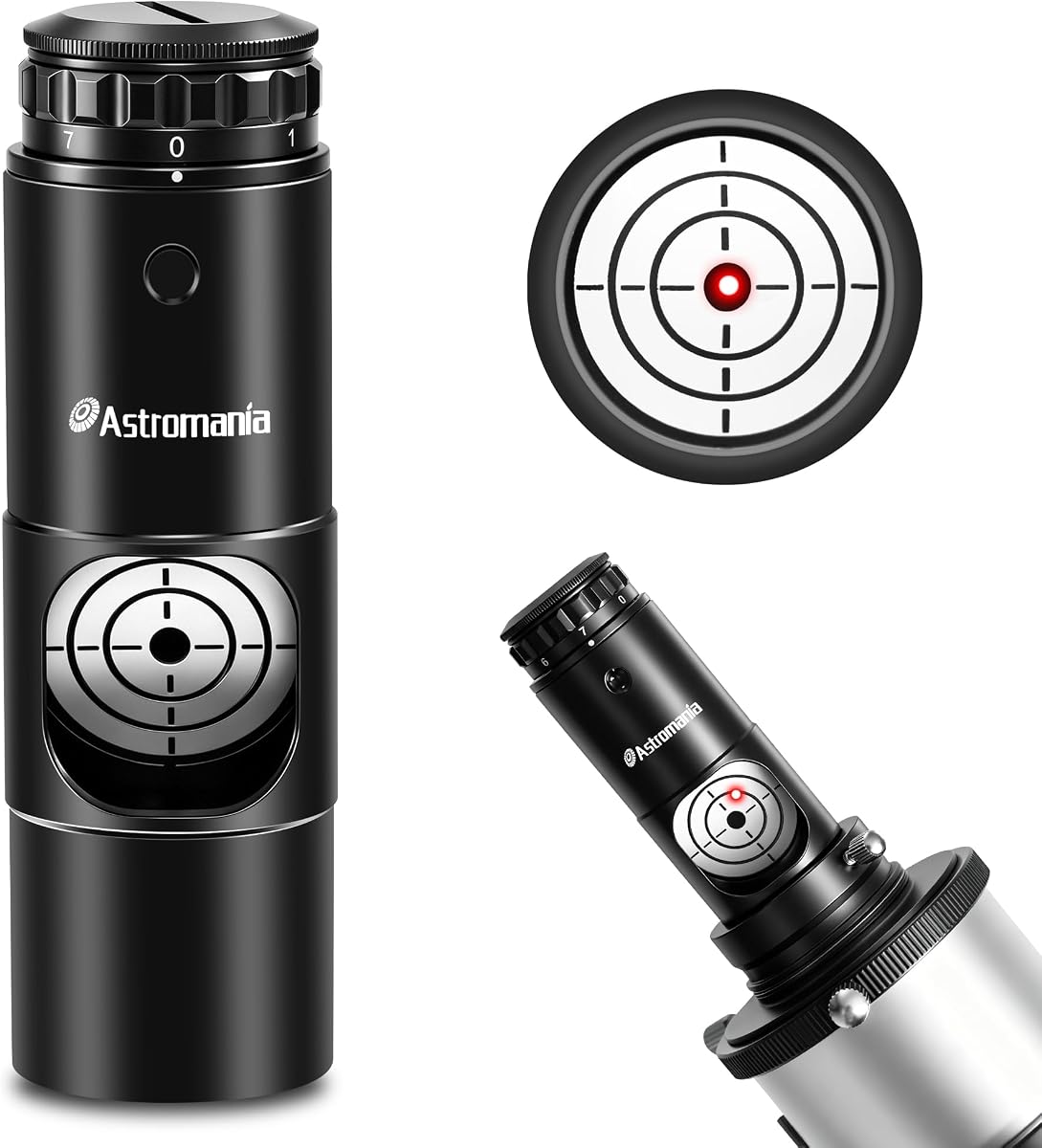
Astromania Laser Collimator 1.25" for Newtonian Marca Telescope Alignment
4.5Editor score
Fits standard 1.25 inch focusers
Durable metal body construction
Includes CR2032 lithium battery
Achieving sharp star images requires precise optical alignment in reflector telescopes. A laser collimator for telescope alignment provides a reliable way to check and adjust your optics quickly.
We reviewed ten top-rated laser collimators based on build quality, compatibility, brightness options, and user feedback. Our list covers budget-friendly options and premium models with advanced features.
Each pick highlights key specs, pros, cons, and ideal use cases. Prices and availability change frequently, so check the links for the latest offers before you buy.
4.5Editor score

4.5Editor score
4.7Editor score
As an Amazon Associate we earn from qualifying purchases.
The table below summarizes key features of all ten laser collimator models. Compare size, adapter options, brightness settings, and included accessories to find your best match.


This Astromania laser collimator offers a solid balance of price and performance for Newtonian telescope owners. It has a high rating from many users who appreciate its ease of use and versatility.
We may earn a commission when you buy through this link, at no additional cost to you.
The standout feature is the removable 2 inch adapter, allowing it to fit both 1.25 and 2 inch focusers without extra parts. The laser has seven brightness levels so you can see it clearly in any light.
While it performs well, the unit may need recalibration after rough handling or drops. Also check if the CR2032 battery is included before you order since packaging can vary by seller.
It is the best choice for most astronomers who want a reliable tool without paying premium prices. If you have a standard reflector telescope this will get you sharp views quickly.
The removable 2 inch adapter saves you from buying a separate collimator if you upgrade your scope to larger focusers.
Seven brightness levels let you match the beam intensity to your environment, whether you are inside or under a dark sky.
We may earn a commission when you buy through this link, at no additional cost to you.
This model is designed specifically for 1.25 inch focusers making it a great pick if you do not have larger optics. It shares many features with the more expensive version but at a lower cost.
We may earn a commission when you buy through this link, at no additional cost to you.
The laser provides seven brightness levels and uses a safe Class 3R beam. Users find it easy to collimate their scopes in minutes thanks to the clear beam and simple adjustment screws.
The main drawback is the lack of a 2 inch adapter which limits compatibility. Also the body does not have a side window for viewing reflections during collimation.
Buy this if you have a standard 1.25 inch scope and want to save money. It is a reliable entry level tool that delivers clear results for visual observing.
The compact body fits naturally in your palm allowing smooth movement within 1.25 inch focusers without strain.
Unlike some competitors this unit often ships with the CR2032 battery included so you can start using it right away.
We may earn a commission when you buy through this link, at no additional cost to you.
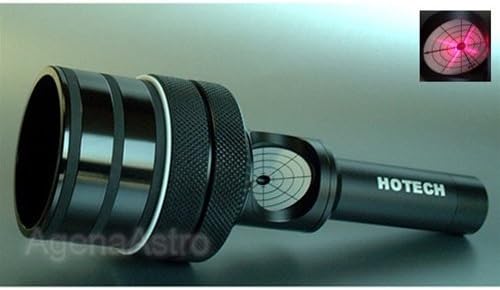
This HoTech collimator stands apart with its patented self-centering adapter technology. It solves the common issue of slop in standard focusers that can ruin alignment accuracy.
We may earn a commission when you buy through this link, at no additional cost to you.
The unit comes with a built-in SCA adapter that fits both 1.25 and 2 inch focusers securely. The crosshair model allows you to see exactly where the laser hits for precise adjustments.
The price is higher than basic models but the accuracy makes it worth it for astrophotographers. Just note it uses a CR123 battery which is less common than CR2032.
Invest in this if you do precision work or have high-end optics. It ensures your laser stays centered even in tight or worn focusers.
The patented SCA mechanism allows precise and repeatable installation in all brands of focusers without introducing off-axis errors.
The crosshair model lets you visualize the alignment point clearly reducing guesswork during the collimation process.
We may earn a commission when you buy through this link, at no additional cost to you.
This SVBONY collimator is an excellent value for reflector owners. It includes a removable 2 inch adapter so you do not need to buy another unit if you upgrade your scope.
We may earn a commission when you buy through this link, at no additional cost to you.
The triple cemented lens improves stability of the red dot beam. Users find it accurate and easy to use even if they are new to telescope collimation.
The instructions are clear but only in German and English. Also check the listing to confirm if the battery is included since it is sometimes sold separately.
It is a great Halloween or birthday gift for astronomy fans. You will get better views without spending a fortune on premium models.
When you upgrade your 1.25 inch telescope to a 2 inch one you do not need an additional calibrator.
This design improves the stability of the red dot so the beam stays consistent during adjustments.
We may earn a commission when you buy through this link, at no additional cost to you.
This bundle adds a telescope lens accessory to the standard collimator. It is useful if you want extra optics for lunar or deep sky viewing alongside alignment.
We may earn a commission when you buy through this link, at no additional cost to you.
The collimator has seven brightness levels and a Class I laser safety rating. The eyepiece gives a wide 62 degree field of view for detailed observations.
The main limitation is the 1.25 inch fit which does not suit larger focusers. Also the rating is a bit lower than the top picks indicating some user variability.
Consider this if you need an extra lens and a collimator in one purchase. It offers convenience for beginners who want a complete kit.
The 62 degree aspheric eyepiece gives maximum detail and definition across the entire field of view.
Output power less than 1mW complies with Class I laser safety standards making it safe for general use.
We may earn a commission when you buy through this link, at no additional cost to you.
This Alstar model is designed for 1.25 inch focusers with a side window to view reflections. It is a simple tool that gets the job done for visual observers.
We may earn a commission when you buy through this link, at no additional cost to you.
The laser comes fully adjusted but can be tweaked if needed. It has seven brightness levels so you can see it clearly in dark or bright rooms.
The battery is often not included so check before ordering. Also the metal build might be a bit lighter than other options but it remains durable.
It is a good choice for beginners who want to learn collimation without spending much. The instructions are precise and help new users get started.
A side window allows a disk oriented at 45 degrees to be viewed to see if the laser reflects back on itself.
The red laser beam has seven brightness levels to suit different light conditions.
We may earn a commission when you buy through this link, at no additional cost to you.
This Alstar unit offers dual 1.25 and 2 inch fit with an included adapter. It shares features with the top picks but often comes at a lower price.
We may earn a commission when you buy through this link, at no additional cost to you.
It has a side window and front emission for accurate monitoring. The triple cemented lens provides stable beam projection during alignment.
Some users note the rating is a bit lower than the Astromania or SVBONY models. It may require recalibration after shipping or handling.
Choose this if you want dual fit without the premium price. It is a solid option for those who need flexibility for different scopes.
Includes a removable 2 inch adapter for telescope upgrades and detailed step-by-step instructions for easy setup.
The triple cemented lens provides stable beam projection while the front and side windows allow accurate reflection monitoring.
We may earn a commission when you buy through this link, at no additional cost to you.
This bundle adds a phone adapter to the laser collimator. It allows you to use your smartphone to capture images through the telescope after collimating.
We may earn a commission when you buy through this link, at no additional cost to you.
The phone clamp fits most devices including iPhones and Samsung Galaxy phones. It uses a steel bolt locking mechanism instead of a spring for better protection.
The collimator has seven brightness levels and fits both 1.25 and 2 inch focusers. Just note the battery is usually not included.
Buy this if you want to start astrophotography without buying separate adapters. It is a practical kit for beginners who want to share their views.
The phone clamping features adjustable locking mechanism with a steel bolt to protect your device during use.
Fits eyepiece diameter from 25 to 48mm making it compatible with many optical devices.
We may earn a commission when you buy through this link, at no additional cost to you.
This bundle includes both a laser collimator and a Cheshire eyepiece for versatile alignment. The Cheshire part does not need batteries and works well during the day.
We may earn a commission when you buy through this link, at no additional cost to you.
The laser has seven brightness levels and fits both 1.25 and 2 inch focusers. Users give this a perfect rating for accuracy and value.
The main downside is the higher cost compared to a single tool. Also the Cheshire part cannot be used at night but the laser covers that.
It is a top choice for those who want multiple alignment methods. You get flexibility and reliability in one package.
The Cheshire collimating eyepiece is precision machined and easy alignment with no batteries needed.
Fits for Newtonian and SCT reflector telescopes and is useful for aligning refractor optics accurately.
We may earn a commission when you buy through this link, at no additional cost to you.
The Ocal Pro V4.0 is a high-tech electronic collimator designed for Newtonian and Schmidt Cassegrain telescopes. It uses built-in calibration circles to guide adjustments with pixel level accuracy.
We may earn a commission when you buy through this link, at no additional cost to you.
It is factory centered so you start with optimal baseline accuracy. The unit is portable and all-in-one making it perfect for field adjustments.
The main drawback is the high price and requirement for a smartphone. Not all astronomers will want to use a phone for alignment.
Consider this if you want cutting-edge electronic guidance. It is ideal for those who prioritize precision and digital tools in their setup.
Built-in software-guided calibration circles enable quick and precise optical axis adjustments with factory-centered pixel-level accuracy.
All-in-one design allows for complete collimation functionality on-the-go perfect for field adjustments and mobile astronomy setups.
We may earn a commission when you buy through this link, at no additional cost to you.
Choosing a laser collimator for telescope alignment involves matching the tool to your scope and skill level. Here are the key factors to consider before you buy.
Check whether your telescope uses a 1.25 inch or 2 inch focuser. Many units come with a removable adapter but some are fixed to one size.
Make sure the collimator fits your focuser snugly without slop for accurate alignment.
Look for a laser with adjustable brightness levels like seven settings. This helps you see the beam clearly in different lighting conditions.
Adjustable brightness makes the tool useful in both indoor and outdoor settings.
Durable metal construction ensures the tool lasts longer and resists wear and tear.
Choose a unit with anodized aluminum or solid metal body for reliability.
Some bundles include extra adapters like a 2 inch sleeve or phone clamp. This adds value if you plan to upgrade or photograph.
Verify if the adapter is included or sold separately before ordering.
Most collimators use CR2032 or CR123 batteries. Check which type is required and if it is included in the package.
Ensure you have the right battery on hand before using the tool.
Units with self-centering or calibration circles offer higher precision for imaging. Standard lasers work well for visual use.
Consider if you need extra features for astrophotography or just visual observing.
Clear instructions in your language help beginners get started quickly. Look for brands that provide step-by-step guides.
Adequate support ensures you can use the tool effectively without frustration.
Check for laser safety ratings like Class 3R or Class I. Safe output power protects your eyes during use.
Always use the tool responsibly and avoid pointing it at people or animals.
Insert the collimator into the focuser and turn on the laser. Make sure it sits snugly without wobble for accurate readings.
Adjust the scope screws until the laser hits the center of the primary mirror. Use the side window or reflection method to verify alignment.
Store the unit in a dry place and keep the battery compartment sealed. Regular checks ensure the calibration stays consistent over time.
A laser collimator for telescope alignment is a tool that emits a laser beam to check and adjust the optical alignment of reflector telescopes. It helps ensure the primary and secondary mirrors are properly aligned for sharp images.
It works best on Newtonian and reflector telescopes. Some models can also assist with Schmidt Cassegrain or refractor scopes but they are designed mainly for reflectors.
If your scope has a 2 inch focuser you will need an adapter. Many units come with a removable adapter so check the product details before buying.
Recalibrate after shipping rough handling or if your scope has been bumped. Frequent use may also require occasional checks to maintain precision.
Yes most units comply with Class 3R or Class I laser safety standards. Still avoid pointing the laser at people or animals during use.
Most models use CR2032 or CR123 lithium batteries. Check the product specs to confirm the exact type needed.
Yes but the beam may be harder to see in bright light. Look for units with adjustable brightness to help visibility in different conditions.
Proper alignment ensures the light path is correct which leads to sharper images. Poor collimation can cause blurry or distorted views.
The top picks include the Astromania dual-fit for versatility and the HoTech SCA for precision. Each has strengths depending on your scope and needs.
Prioritize dual adapter options if you plan to upgrade. Also consider whether you need extra features like phone adapters or Cheshire bundles.
Check current prices and availability before you buy. Tools and accessories can change so verify the latest deals on the product pages.