
QWORK RC Battery Capacity Checker
4.7Editor score
Clear voltage information display
Compact portable design
Multi-cell support range
This guide compares the top Li Ion Battery Tester models for accuracy and features to help you choose the right device for your specific battery needs.
Finding the right Li Ion Battery Tester ensures your rechargeable cells perform safely and efficiently. These devices measure voltage, capacity, and internal resistance to prevent failures in your gadgets and projects.
We evaluated ten leading testers based on compatibility, display clarity, and measurement precision. Each model supports different chemistries and cell counts to meet the needs of hobbyists and professionals alike.
Every pick below shows key specs and real-world performance insights. Prices and availability change often, so check the latest offers before making your final decision on which tester to buy.
4.7Editor score

4.7Editor score

4.5Editor score
This side-by-side comparison highlights the unique strengths of each Li Ion Battery Tester model. Review the specifications below to see which device fits your testing requirements and budget constraints.




This Li Ion Battery Tester provides a comprehensive solution for checking 18650 cells with four independent channels. It features a digital display that tracks voltage, current, and capacity metrics simultaneously for efficient batch testing.
We may earn a commission when you buy through this link, at no additional cost to you.
The device measures internal resistance and capacity up to 99999mAh while operating on DC5V. Its Type-C port ensures modern connectivity, and the integrated charge and discharge function reduces the need for manual battery swapping during routine checks.
Users may find the measurement error rate around ten percent slightly high for critical precision work. Additionally, the manual requires contacting the seller directly after purchase, which adds a small step to the setup process.
This tester suits hobbyists managing multiple 18650 batteries who need basic data without high cost. It is a practical choice for those prioritizing channel count over extreme precision in their battery maintenance routine.
The four-channel design allows you to test multiple batteries at once, significantly speeding up maintenance for large collections.
Real-time voltage and power readings help you monitor discharge curves and detect anomalies immediately during testing.
We may earn a commission when you buy through this link, at no additional cost to you.
This Li Ion Battery Tester stands out for its universal compatibility with household and button cells. The magnetic slot design ensures batteries stay in place during testing, making it easy to use with one hand.
We may earn a commission when you buy through this link, at no additional cost to you.
It features an LCD that shows whether a battery is good, weak, or poor based on voltage. The device is rechargeable via USB-C and lasts up to 15 hours on a full charge, eliminating the need for replacement cells.
The absence of a power adapter in the package means you must supply your own USB wall brick. While it excels at voltage checks, it does not measure capacity or internal resistance like specialized lithium testers.
Ideal for home users managing AA, AAA, and 9V batteries alongside occasional lithium cells. Its convenience and long battery life make it a reliable companion for daily household power checks.
The magnetic slider secures the battery firmly so you can read results without holding the cell manually.
A single charge lasts up to 15 hours so you can test many batteries before needing to recharge again.
We may earn a commission when you buy through this link, at no additional cost to you.
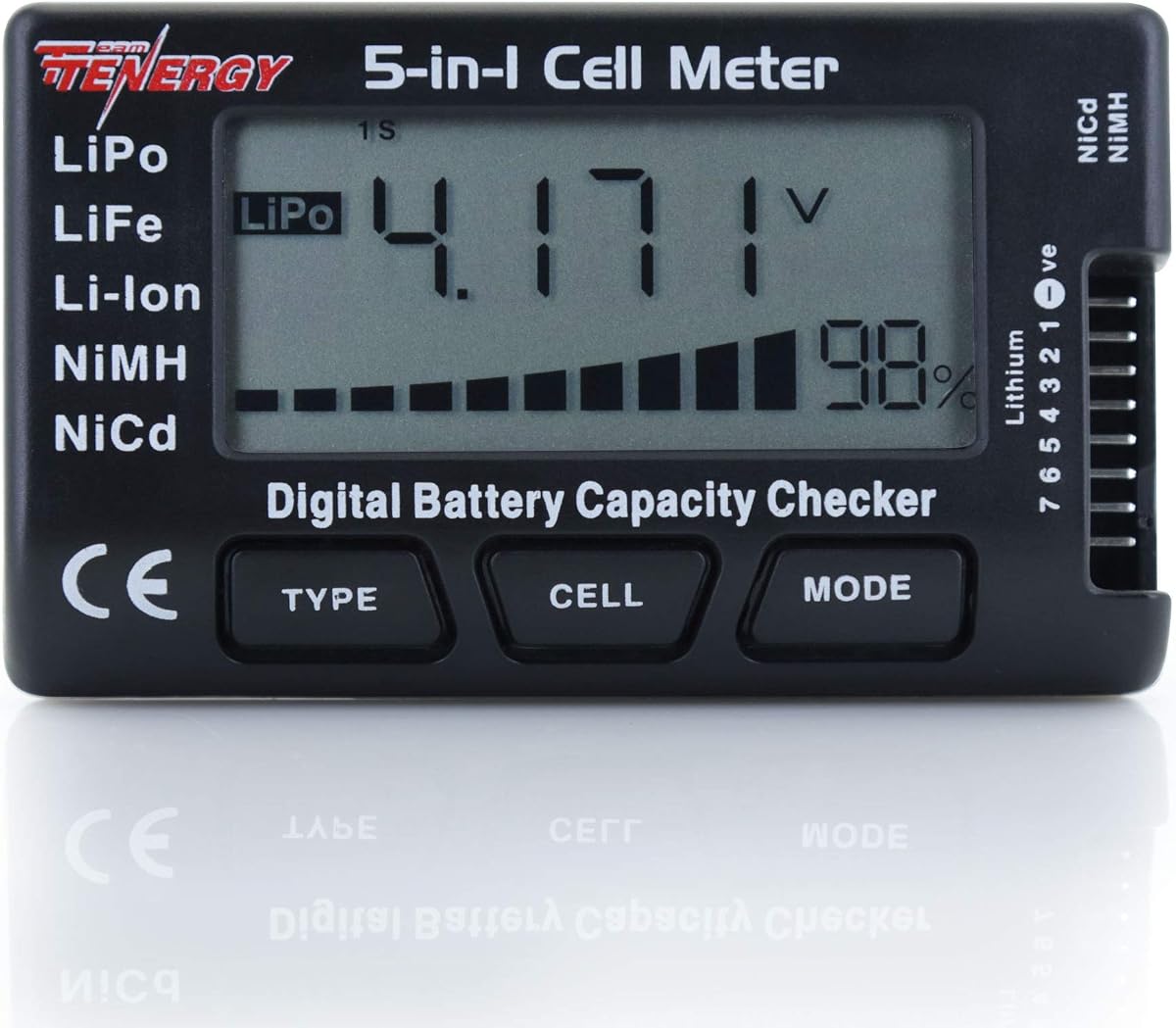
The RC Cellmeter 8 offers precise voltage testing for LiPo, Li-ion, NiMH, and Nicd packs in a compact form. Its large LCD and one-click button simplify operation even for users new to RC electronics.
We may earn a commission when you buy through this link, at no additional cost to you.
Safety is a priority with a minimum operating voltage of 1.2 volts to prevent damaging low-power devices during measurement. The meter provides both individual cell voltage and total pack readings for quick health assessments.
It does not offer capacity discharge testing or cell balancing features found in more advanced tools. This limits its utility for deep maintenance but keeps the price accessible for casual hobbyists.
Best suited for RC enthusiasts needing a quick reliable check before flights or runs. Its safety features and simple design make it a trustworthy addition to any toolkit.
The minimum operating voltage threshold ensures you do not drain devices further while testing their battery status.
The large screen displays cell voltages clearly so you can spot weak cells without squinting in the field.
We may earn a commission when you buy through this link, at no additional cost to you.
This Li Ion Battery Tester combines cell metering with balancing and discharging functions to maintain lithium packs effectively. It connects directly to balance connectors without needing additional power supplies or accessories.
We may earn a commission when you buy through this link, at no additional cost to you.
The balancer optimizes performance by ensuring individual cells remain equal, which extends overall lifespan. It also measures internal resistance so you can decide when to replace aging packs before they fail.
Since it draws power from the battery pack being tested, ensure the pack has enough charge to run the meter. Connector support is specific to balance ports or Hitech/Futaba types which may limit some applications.
Perfect for RC pilots and modelers who want an all-in-one tool for pack health and maintenance. The balancing feature sets it apart from basic voltage testers in terms of long-term battery care.
By keeping cells balanced you reduce stress on individual cells and significantly extend the usable life of your battery.
Internal resistance readings reveal hidden degradation so you avoid using weak cells that could cause unexpected shutdowns.
We may earn a commission when you buy through this link, at no additional cost to you.
The FLY RC Cellmeter 7 is a lightweight and durable tool for checking LiPo, Li-ion, and NiMH packs. It displays cell voltages, total voltage, and the gap between highest and lowest cells for quick diagnostics.
We may earn a commission when you buy through this link, at no additional cost to you.
Its compact size makes it easy to carry in a flight bag or toolbox. The display mode includes remaining capacity percentage which helps estimate flight time or run duration without complex calculations.
It does not perform capacity discharge testing so you rely on voltage trends to infer health. The cell range covers common setups but may not support extreme configurations used in specialized applications.
This tester is ideal for RC hobbyists who need a simple and portable solution for pre-flight checks. Its clear display and lightweight build ensure you can check batteries anywhere without hassle.
Viewing the voltage gap helps you identify unbalanced cells immediately without needing a separate balancing device.
The lightweight design ensures the meter adds minimal bulk to your gear so it is always ready when you are.
We may earn a commission when you buy through this link, at no additional cost to you.
This Li Ion Battery Tester works with BattGO technology to offer deep insights into battery cycles and detailed parameters. It supports multiple connections including XT60 and balance leads for broad compatibility with RC and power tools.
We may earn a commission when you buy through this link, at no additional cost to you.
The auto balancing algorithm ensures cells are equalized which optimizes performance. It also doubles as a power bank with Qualcomm QC support allowing you to charge phones or devices while on the go.
Using BattGO fully requires connecting an XT60i which adds a specific hardware requirement. The price is higher than basic meters but justified by the extra features and smart functionality it provides.
Best for tech-savvy users who want advanced data and utility in one device. The combination of testing, balancing, and power bank functions makes it a versatile tool for modern electronics.
BattGO technology reveals cycle counts and detailed parameters so you understand battery history beyond simple voltage.
When connected to a pack the device can also charge your mobile devices making it useful during power outages.
We may earn a commission when you buy through this link, at no additional cost to you.
The ISDT BG-8S Battery Meter delivers smart testing with BattGO integration for detailed cycle and voltage data. It supports auto-balancing and protocol analysis making it suitable for complex RC setups and smart batteries.
We may earn a commission when you buy through this link, at no additional cost to you.
It includes receiver signal tests for PWM and PPM protocols which helps diagnose control issues alongside battery health. The power bank feature with 12V output adds versatility for charging devices in the field.
The interface requires some setup to unlock full protocol support via firmware updates. While powerful it demands a bit more learning time compared to simpler voltage checkers available on the market.
This unit is the top choice for professionals needing comprehensive diagnostics in one portable unit. Its combination of balancing, protocol analysis, and power bank utility offers unmatched value for serious users.
Testing PWM and PPM signals helps you troubleshoot receiver issues that might otherwise be mistaken for battery problems.
Cycle count tracking allows you to predict when a battery will degrade so you can replace it proactively.
We may earn a commission when you buy through this link, at no additional cost to you.
This Li Ion Battery Tester offers eight independent channels for simultaneous testing with real time voltage and current displays. Its advanced design includes active heat dissipation to maintain accuracy during long testing sessions.
We may earn a commission when you buy through this link, at no additional cost to you.
The device supports automatic charge and discharge cycles which simplifies routine maintenance without manual intervention. Reverse connection protection ensures safe handling and prevents damage to the tester or batteries during setup.
It is specialized for 18650 cells so it may not suit other form factors. The premium price reflects the high precision and advanced features which may be overkill for casual home users.
Best for labs and professionals managing large batches of 18650 batteries for reliability. The precision and automation features save significant time and ensure consistent results across all tested units.
Active heat dissipation keeps the device cool during long tests so accuracy remains stable over time.
Reverse connection protection prevents accidental damage if you plug in a battery incorrectly during setup.
We may earn a commission when you buy through this link, at no additional cost to you.
This Li Ion Battery Tester provides clear voltage information for LiPo and NiMH packs with a lightweight design. It supports 2 to 7S packs and shows total voltage as well as min/max cell readings for quick checks.
We may earn a commission when you buy through this link, at no additional cost to you.
The digital screen offers instant readings which is essential when preparing drones or cars for flight or drive. Its compact size makes it easy to stash in a pocket or gear bag without taking up space.
It requires balance connectors and cannot test single cells so it is limited to multi-cell packs. For its price it delivers reliable performance but lacks capacity discharge features found in larger units.
Ideal for RC users who need a portable and affordable tool for pre-flight checks. Its clarity and convenience make it a practical choice for field work and hobby maintenance.
The digital screen updates quickly so you can assess battery health before connecting it to your device.
The compact build ensures you can carry it easily during outdoor activities without adding bulk to your setup.
We may earn a commission when you buy through this link, at no additional cost to you.
The ZTS Mini Multi-Battery Load Tester uses patented pulse load technology to measure battery life under load. It automatically identifies weak or failing batteries in seconds without requiring any switches or settings.
We may earn a commission when you buy through this link, at no additional cost to you.
It tests various types including 1.5V alkalines and 1.2V NiMHs giving you a reliable health percentage before recycling or replacing. The compact design allows you to store it easily in a drawer or travel kit.
The probe and lead wire store in the seam which is convenient but can be fiddly to open quickly. It does not provide capacity data like mAh but focuses on immediate reliability for household needs.
This unit is perfect for home use to manage flashlight and remote batteries efficiently. Its simplicity and American manufacturing ensure durability and ease of use for daily checks.
Measuring under load reveals true battery health which a simple voltage check might miss during idle conditions.
No switches or settings mean you can start testing immediately without learning complex menus or modes.
We may earn a commission when you buy through this link, at no additional cost to you.
Selecting the right Li Ion Battery Tester depends on the battery types you manage and the level of detail you need.
Ensure the tester supports the specific chemistries and voltages of your batteries. Some models work only with Li-ion or LiPo while others include NiMH and alkaline options for broader use.
Choose a device that matches your primary battery chemistry to avoid compatibility issues and ensure accurate readings across all your packs.
Decide if you need simple voltage checks or full capacity discharge testing. Voltage testers are faster but discharge testers provide deeper insights into actual battery health and remaining capacity.
Opt for capacity testing if you require precise data on battery lifespan and performance over time.
A clear LCD or color screen helps you read data quickly especially in low light conditions. Look for displays that show individual cell voltages and total pack voltage simultaneously.
Prioritize screens with readable fonts and contrast to prevent errors when interpreting critical battery metrics.
Check which connectors the tester supports such as balance leads or balance ports. Some units offer multiple input types for universal compatibility while others focus on specific RC connectors.
Ensure the available ports match your battery's output style to avoid needing extra adapters during testing.
Some testers are powered by the battery being tested while others use internal rechargeable cells or USB inputs. Rechargeable units offer more flexibility but require their own charging routine.
Consider how convenient the power source is for your workflow before purchasing a specific model.
If you need to test batteries on the go choose a lightweight and compact design. Portability ensures you can carry the device to field work or storage areas easily.
A smaller footprint helps you store the tester conveniently when it is not in active use.
Advanced models may include balancing functions protocol analysis or power bank capabilities. These features add value but may increase complexity and cost significantly.
Only select extra features if they address specific needs in your battery management routine.
Look for testers with protection against reverse connection and over-discharge to prevent damage to batteries or the device. Accuracy ratings should be clearly stated by the manufacturer.
Safety features ensure safe operation while accurate measurements help you make informed decisions about battery replacement.
Always connect the tester to the battery according to the specified polarity and connector type. Verify the battery voltage range before testing to ensure the device can handle the input safely.
Keep the device clean and dry when not in use. Dust and moisture can affect the accuracy of the sensors and the quality of the electrical contacts.
Regularly calibrate or check the device against known reference batteries to maintain measurement accuracy over time. Proper storage in a cool environment extends the life of internal electronics.
A voltage tester measures the current electrical pressure of a battery while a capacity tester measures how long the battery can discharge under load. Capacity testers provide more accurate health data than voltage readings alone.
Many Li Ion testers focus on lithium chemistries but some universal models include settings for alkaline cells. Check the compatibility list before buying to ensure your alkaline batteries are supported.
Internal resistance indicates how efficiently a battery delivers power. High resistance means the battery may underperform or overheat even if voltage readings appear normal during idle checks.
Not all testers show individual cell voltages especially simpler single-pack models. Balancer and multi-cell meters usually provide per-cell data to help identify weak spots in the pack.
Test your batteries before major projects or monthly during regular use to catch degradation early. Consistent testing helps prevent unexpected failures and extends the useful life of your power sources.
Some advanced models offer integrated charge and discharge functions but many only measure. Verify if charging capability is included if you need a single device for both charging and testing.
We reviewed ten top Li Ion Battery Tester models ranging from compact voltage checkers to advanced multi-channel analyzers. The ISDT BG-8S and Advanced 8 Channel Tester stand out for users needing precision and smart features.
Prioritize battery compatibility and measurement accuracy to ensure your testing process is efficient and safe. Matching the device to your specific battery chemistry and format saves time and prevents damage.
Check current availability and prices on Amazon to find the best deal for your needs. Selecting the right tester today ensures your batteries perform reliably for all your projects.